

From 1 April 2029, VAT invoices in the UK will have to be issued and received as e-invoices. The government announced the date at Budget 2025 and published an implementation roadmap in October 2026. For a business with five people, where one person writes the invoices between other jobs, that raises a practical question: what actually has to change, and when?
Germany is a few years ahead. German businesses have had to be able to receive e-invoices since January 2025, and the duty to issue them follows in 2027 and 2028, depending on turnover. A few things from that rollout are useful for UK owners who would rather not start from zero.
What the roadmap says so far
From 1 April 2029, VAT-registered businesses and public bodies will need to be able to issue and receive VAT invoices as e-invoices, unless an exemption applies. The government’s roadmap expects the exemptions to be limited, for example for people who are digitally excluded.
An e-invoice here means structured invoice data that moves directly between your system and your customer’s system. A PDF sent by email doesn’t count. The UK will use Peppol as the core network for exchanging them, and most businesses will reach it through an access point provided by their software supplier.
Invoices to consumers and to customers who aren’t VAT-registered are outside the scope, because a VAT invoice isn’t required for those sales in the first place.
The detail isn’t settled yet. The government says it will confirm the scope, the exemptions and the technical standards between October 2027 and April 2028, with at least 12 months’ notice before the rules apply.
What Germany’s first years show
The German tax authorities have published guidance on how the rules work in practice. The IHK Köln summarises the Federal Ministry of Finance’s letter of October 2025. Three points carry over.
The structured part is what counts. The details that matter for VAT, such as what was actually supplied, have to be in the structured data. A readable attachment can add detail, but it doesn’t replace it.
Errors come in different kinds. The ministry separates format errors, business-rule errors and errors in the VAT content. A failed technical check doesn’t automatically cost the buyer the VAT deduction, but it is a good reason to look at the invoice before it gets booked.
Receiving came first. German businesses had at least two years to get used to incoming e-invoices before they had to send their own. In the UK, issuing and receiving start on the same day.
A checklist for a five-person business
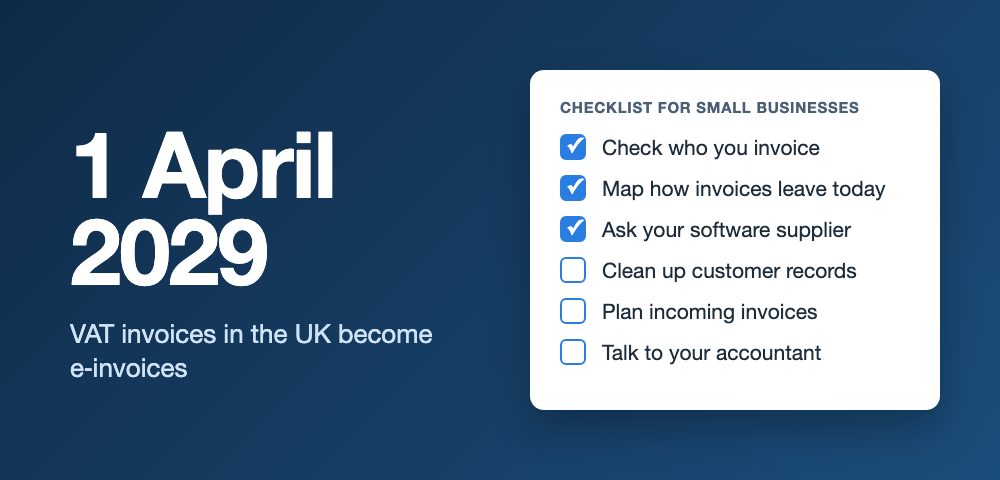
1 Check who you invoice. Only VAT invoices to VAT-registered customers are affected. Count how many of your invoices go to businesses and how many to consumers.
2 Write down how an invoice leaves the business today. A Word or Excel template, accounting software, who sends it, to which email address.
3 Ask your software supplier. The roadmap notes that several providers already offer e-invoicing, and some have said they will include it in their core package at no extra cost. Ask whether yours will, and whether it will work through Peppol.
4 Clean up your customer records. A structured invoice reads names, addresses, VAT numbers and purchase order references from fields. Records that are incomplete, or spelled three different ways, are easier to fix now than under a deadline.
5 Decide who receives and checks incoming invoices. From 2029 your suppliers’ invoices will arrive as data too, and someone has to open them, check them and book them.
6 Talk to your accountant, and put October 2027 in your diary. That is when the government starts to confirm the detailed requirements.
Why start before the rules are final
The roadmap itself gives some numbers. Late payments cost the UK economy £11 billion a year, and small businesses spend 86 hours a year, on average, chasing them. It also cites industry research suggesting the smallest businesses could save five hours and forty minutes a week with e-invoicing. Those are estimates, and your own figure will differ. But an invoice that arrives complete and correct is easier for the other side to pay, and that part is worth getting right whatever the final rules say.
Author: Timo Kleemann
Timo Kleemann is the founder of BillingEngine, an online invoicing and bookkeeping application based in Hamburg, Germany. He has worked on e-invoicing since German businesses had to start receiving e-invoices in 2025, and studied international business and information technology in England.