

Max Bascombe, CFO at SignpostMe, argues that CFOs need to take note. The UK government is signalling that employers should carry a larger share of the burden for the nation’s health.
The NHS is stretched. In June 2026 7.3 million treatments were yet to start and only 65.8% of  patients had been seen within the Government’s 4-months goal of 92%. Patients suffering a wait of over a year to be treated has risen by 12% between March and June 2026 to 105,711. Public satisfaction with the NHS is a meagre 26% – a 40-year low – with 51% of the public dissatisfied overall. The NHS retains deep public affection, but affection is not the same as confidence that care can be delivered in reasonable time – and each headline about a treatment scandal erodes that confidence further.
The benefits bill is increasing the pressure on the Exchequer with an annual cost of £65bn expected to pass £100bn by 2029-30.
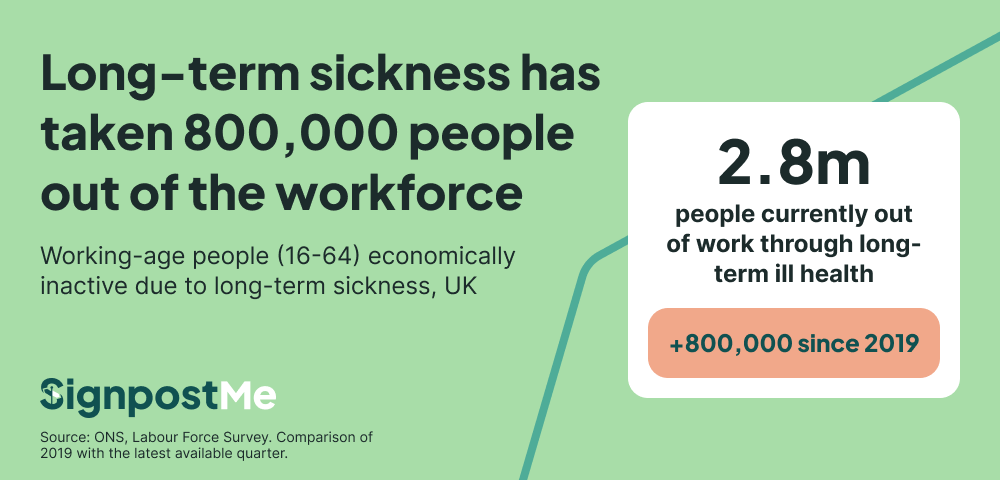
Sharply rising level of economic inactivity due to long-term illness (up 850,000 in the last 3 years to 2.8million) exacerbates the problem in terms of NHS budgets and DWP staffing levels. Yet the prospect of meaningful reform and the damaging headlines that would result is slim – but politicians cannot keep kicking the can down the road.
Employers are the more palatable option available to the Government. Sir Charlie Mayfield’s “Keep Britain Working” review set out a shared responsibility model with employers handling prevention, early intervention and return-to-work support through a new Workplace Health Provision, while the NHS concentrates on diagnosis and treatment.
The review is silent on fiscal incentives – for example, enhanced tax relief on health spending or reduced employer NIC for firms investing in staff health. This creates uncertainty for CFOs. Will government default to a regulatory stick of auto-enrolment into a baseline level of workplace health cover? or borrow the R&D tax credit model to corporate healthcare spend? Maybe a phased approach – voluntary incentives first, mandating later if take-up disappoints? But can companies afford it?
The good news for CFOs is that there are definitive financial benefits to providing improved health benefits to employees – a healthier, faster-treated workforce means less absence, less presenteeism and better retention. For many employers the arithmetic is already working without Government intervention, with workplace policies now covering 4.8 million employees.
However, driven by the same underlying pressures faced by the NHS (an aging population and an increased demand for treatments to name but two) health insurance premiums are rising fast. And employers are still absorbing the April 2025 rise in employer NIC This particularly impacted companies with a high employee-number to turnover ratio as they would tend to have single digit net profit margins. Payrolled employment fell by an estimated 96,000 to 109,000 in the year to January 2026. Any new mandatory healthcare cost layered on top, without an offsetting fiscal benefit, would land on a labour market that is already under pressure.
On the less likely (but necessary) reform of the benefits system, several European countries set unemployment benefit higher in value relative to health-related benefit than in the UK. This changes the incentive facing someone out of work. The UK system nudges claimants away from actively seeking a job and toward seeking a medical sign-off – consuming already scarce clinical capacity. A fundamental shift in benefit design would be unpopular and take years to legislate and bed in – which is why it is the least likely course to be adopted by the government.
For CFOs, clarity will not arrive soon. The direction of travel – more employer responsibility for workforce health – is a journey that has already begun. It is reasonable to assume this growing corporate contribution to healthcare costs will be accompanied by a combination of voluntary investment, tax incentive (hopefully) and regulation.
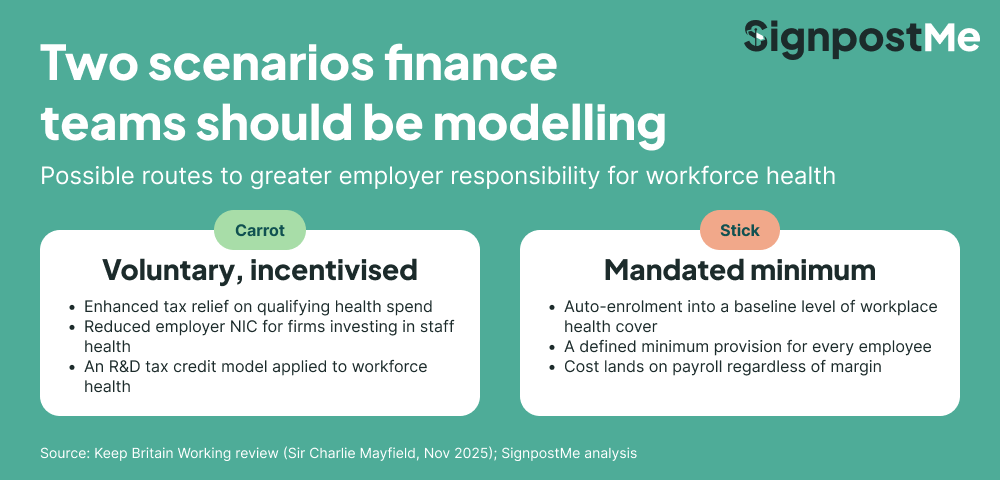
Building healthcare cost scenarios into financial plans, engaging now with the Keep Britain Working Vanguard Phase to help shape its design, and modelling both a carrot scenario (tax relief, lower employer National Insurance on qualifying spend) and a stick scenario (mandatory minimum provision) is no longer speculative work.
“SignpostMe offers employers a third option between doing nothing and buying expensive PMI. Building on its diagnostics heritage, it combines rapid diagnosis, optional treatment cover and wellbeing support, helping people get answers sooner rather than waiting until they are seriously unwell. Premiums are linked only to age and not to claims, as for other PMI schemes, so employers can forecast the cost of workforce health with confidence over the long term.”