
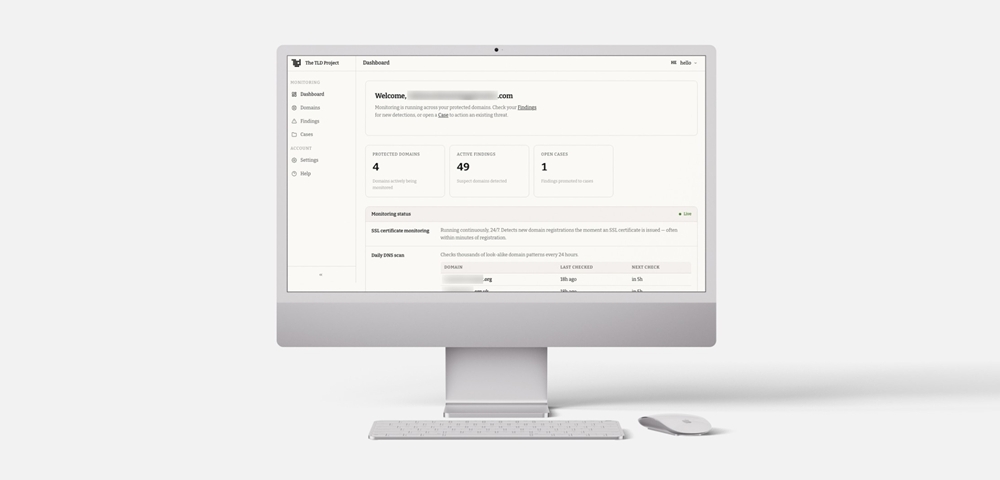
Unlimited Application has launched The TLD Project, a monitoring and takedown service for lookalike web address impersonation. The UK Government’s Cyber Security Breaches Survey 2025/2026 found that 12% of businesses identified someone impersonating their organisation or staff in emails or online during the previous 12 months.
Lookalike web address fraud, where someone registers a web address resembling a trusted business and uses it to mislead customers, suppliers or partners, sits outside the scope of Cyber Essentials, the UK Government-backed certification scheme. Its five technical controls protect the organisation’s own IT systems. They were never designed to detect an impersonating web address registered by someone else.
Businesses register their main web address and several defensive alternatives. There are more than 1,400 active top-level domain extensions worldwide, according to IANA’s Root Zone Database. Someone impersonating that business needs only one the business does not own.
Marketing agency KEXINO first learned that someone was using its identity when a cease-and-desist letter arrived from Germany. Another party had registered a web address using the agency’s name under the .de domain extension, copied the agency’s branding and linked to its genuine site. The agency was receiving complaints about activity it had not carried out. Because the .de extension was used, the legal response had to follow German law. KEXINO needed a German lawyer to respond. This was a requirement of the jurisdiction, not a choice. Resolving the situation took four months and cost thousands. No part of the agency’s existing IT security had detected the impersonation, because the lookalike web address operated entirely outside its own systems.
“I know the impact, stress, business disruption and reputational damage this causes. We had the combined knowledge to act quickly — an advantage most businesses do not have internally.” — Gee Ranasinha, CEO, KEXINO
The exposure works in both directions. Someone can impersonate a business to deceive its customers, suppliers or members. Equally, someone can impersonate a trusted supplier or partner to deceive the business itself, for example through a payment request with changed account details or an invoice that looks routine. Neither scenario necessarily requires a compromise of the impersonated organisation’s systems. Protecting those systems does not, by itself, establish whether a lookalike address is operating elsewhere. The Federation of Small Businesses’ 2023 report, Cracking the Case, found that 92% of small businesses that had experienced cybercrime reported phishing.
AI is making the problem faster, cheaper and harder to spot. The UK’s National Cyber Security Centre has warned that generative AI can already create convincing documents and interactions free of the errors that once helped people identify fakes, and that AI is lowering the barrier for less skilled attackers. Marketplace reported in February 2026 that cybersecurity firm Netcraft had identified 100,000 AI-generated sites impersonating nearly 200 brands during 2025. An impersonating web address no longer requires a skilled attacker. It requires a prompt.
After the KEXINO incident, Nick Brittan, founder of Unlimited Application and a long-standing associate of Ranasinha, looked for a monitoring service that a small business could use without specialist knowledge or an enterprise budget. He could not find a service that met those requirements.
Brittan developed two initiatives. TLD Aware (tldaware.com) is a free educational resource developed for associations and small businesses to understand the real risk: what lookalike web address impersonation is, how it works, and why it is getting worse as AI lowers the barrier. The TLD Project (thetldproject.com) is the monitoring and takedown service: it watches for lookalike web address registrations, gathers technical evidence, and prepares structured reports the business sends from its own email.
“This is not an IT problem. It is a business risk that sits outside the systems your IT provider manages. In most organisations, nobody is responsible for looking.” — Nick Brittan, Founder, Unlimited Application
The TLD Project is available now at £54 + VAT per year for the first 100 subscribers, with a three-month trial and a full money-back guarantee, renewing at £99 + VAT per year. A single subscription covers one core web address, monitoring for potential lookalikes, evidence gathering and unlimited takedown reports. No technical knowledge is required.
The question most businesses have not yet asked is whether anyone in their organisation is monitoring for lookalike web addresses impersonating them, or impersonating the businesses they trust.