
By Tahir Javed Kashif
A small business can run smoothly while its owner is present and still be difficult for somebody else to run. The owner knows which customer needs a reassuring call, which supplier will accommodate a late order and which exception in the quoting process matters. None of that necessarily appears in a process manual.
For a UK owner-manager considering a future sale, succession or a less hands-on role, the useful question is not simply whether procedures exist. It is whether another person can use them. A carefully controlled handover rehearsal can help answer that question before a transaction makes every unresolved detail urgent.
This is an operational exercise, not a valuation method or a substitute for professional due diligence. Its purpose is to expose dependence on the founder while there is still time to do something about it.
Start with one ordinary workflow
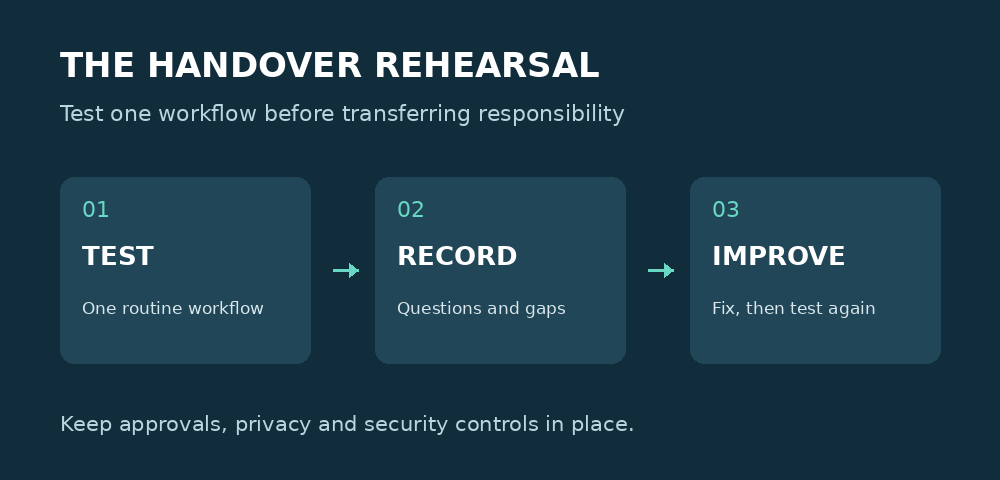
Do not begin by asking the owner to disappear for a fortnight. Choose one recurring, manageable workflow: preparing a standard quotation, scheduling a service visit, resolving a routine customer query or preparing an invoice for approval.
Name a responsible colleague and agree the boundaries. Which decisions can they make? Which require approval? What would trigger an immediate escalation? Keep existing safeguards over payments, confidential information and system access. A rehearsal is not permission to share passwords or weaken controls.
Then ask the colleague to complete the work using the records and authority already available to them. The founder can remain reachable for genuine exceptions without supplying every answer in advance. That distinction matters: the aim is to test the process, not the colleague’s ability to read the owner’s mind.
Keep a decision log, not a blame list
Each time the work stops, record the question, the missing information and who could resolve it. Separate three different problems: information that was not documented, a decision nobody had authority to make, and a judgement that genuinely requires specialist experience.
Imagine a small maintenance company where a supervisor can schedule jobs but cannot quote an unusual call-out without the founder. This is a hypothetical example, not a client case. The problem may be missing pricing guidance rather than an incapable supervisor. A sensible response could be a written decision range, a list of exceptions and a clear approval route.
Do not reduce every judgement to a rigid script. Some decisions should remain with an experienced person. The practical goal is to make that dependency visible and provide a credible route for handling it.
Test customer continuity separately
A process document cannot prove that customers will accept a different point of contact. Review where relationships sit: with the company, a team or the founder personally. Identify who understands the account history and who can answer routine questions without forwarding them to the owner.
Where appropriate, introduce a second responsible contact through ordinary service activity. Do not announce a sale that has not been agreed or turn a rehearsal into a misleading message to customers. Sensitive communications should follow a deliberate plan.
Keep relationship continuity distinct from contract transferability. A customer liking the new contact does not establish that a contract can transfer to a buyer. Ask the solicitor advising on the actual transaction to assess the relevant agreements and proposed structure.
Make the handover evidence usable
At the end of the exercise, retain a compact record: the workflow tested, its responsible person, the interruptions, the fixes agreed and the date for another test. A page of clear findings is more useful than a large folder nobody maintains.
Avoid scoring the business as ‘sale ready’ because one test went well. Repeat the exercise across different activities and circumstances. A routine week may reveal little about a customer complaint, a staff absence or an urgent supplier problem.
If a sale process begins, discuss with advisers which findings are useful to share and at what stage. Share proportionately through controlled channels rather than circulating customer files or employee information in an introductory email. An honest record of an unresolved dependency is better than an unsupported statement that the founder is no longer needed.
Give each gap a practical next step
Choose a small number of improvements with a named owner and a review date. That might mean recording quotation assumptions, identifying a backup supplier contact or training a second person to prepare the weekly operating report. Test the change before calling it complete.
The British Business Bank’s due diligence guidance treats operational structure, people, systems and processes as matters to examine alongside finances. ICAEW’s succession guidance likewise emphasises a written transition plan and time for a successor to learn. A handover rehearsal is one practical way to start that preparation; it does not prove the outcome of a future sale.
The benefit is useful even if no buyer appears. Instead of assuming that the business can run without constant founder intervention, the owner has tested one part of that assumption and knows what to improve next. Start small, retain the safeguards and repeat. The next handover should depend less on memory and more on a process another person can actually use.
About the author
Tahir Javed Kashif is the founder of sellanybiz.com, a business buying-and-selling platform. He is a Dubai-based entrepreneur with 20 years of UAE experience and hands-on experience buying and selling businesses.