
By Robin Gibbons
An advertising dashboard cannot tell you whether someone in your business knows what to do with an enquiry. A visitor may complete a form, see a reassuring message and wait for a reply, while the request sits somewhere nobody checks.
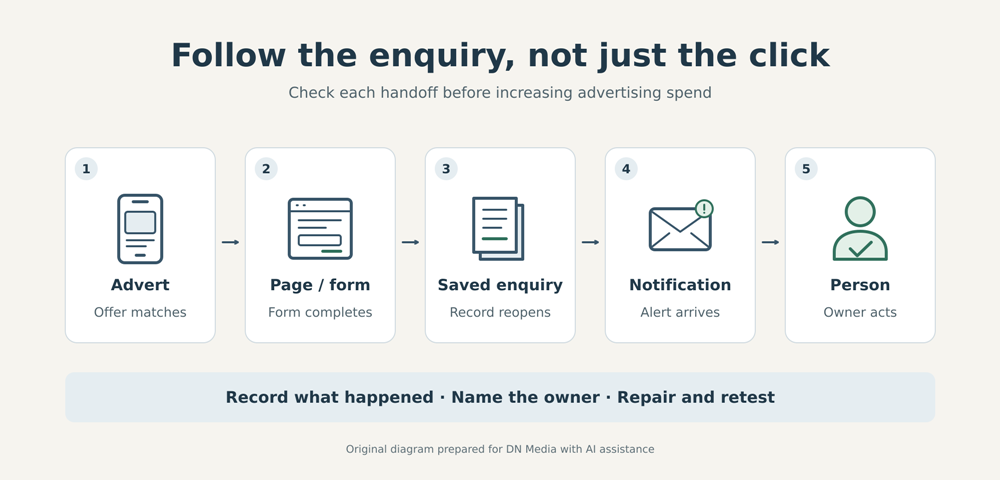
Before buying more visits, follow one test request from the advert to the person responsible for responding. The question is not simply, “Does the form work?” It is, “Can we account for each handoff, and does somebody own the next step?”
This is a useful exercise for an owner-managed business where the website, advertising and enquiries may be handled by different people. It separates a broken route from an unsuitable enquiry, so each problem goes to the right person.
Set up a traceable test
Choose one live campaign destination and the offer it promises. Write down what someone should expect after enquiring: a quotation, a discussion about availability or another clearly described next step. Do not substitute a promise your business cannot keep.
Arrange an approved test with whoever manages the website and enquiries. Use synthetic details, a contact address you control and a distinctive test reference. Avoid customer information. Prevent the test from starting real bookings, messages to customers or other unintended work, and exclude it from performance reporting.
Start on a phone using the actual destination linked from the advert, not the homepage you remember. If visitors open it inside a social app, test that route too. Have the intended responder available to check the other end.
Five-row journey worksheet
For each row, record what actually happened, who owns any repair and when to retest. A blank observation is a question still to answer, not a pass.
| Handoff | Evidence to look for | Actual observation | Owner / repair / retest |
| 1. Advert to mobile page | The offer, relevant service limits and next step remain recognisable at the exact destination. Record the advert wording and destination URL. | ______ | ______ |
| 2. Mobile page to completed form | Submit with a required field missing, then correct it. Can you understand the error and continue without losing everything you entered? Record the result. | ______ | ______ |
| 3. Submit to saved enquiry | Find the distinctive test reference in the system used to retain enquiries. Reopen the record and check the details. Compare this with the confirmation shown to the visitor. | ______ | ______ |
| 4. Saved enquiry to notification | The intended recipient can find the test alert and open the right record. Note where it arrived. A notification service accepting a message is not proof somebody received it. | ______ | ______ |
| 5. Notification to responsible person | The responder can find the request, accept ownership and record the next action. Name the cover arrangement if that person is absent. | ______ | ______ |
Do not let one green tick stand for five
The worksheet is useful because it locates the uncertainty. If the page opens but the offer changes, the first handoff needs attention. If a confirmation appears but nobody can find the saved request, investigate storage before buying more traffic. A reassuring screen is not a substitute for the record.
If the record exists but the alert does not arrive, examine the notification route rather than rewriting the advert. If the alert arrives but nobody takes responsibility, the immediate problem is operational ownership. Adding another dashboard will not resolve an unassigned task.
Ask the person responsible for each failed row to describe the repair and repeat that part of the journey. The customer-facing confirmation should say only what has happened. Saving a request does not necessarily mean a team member has read it or that an appointment is booked.
A successful test shows that this route worked on this occasion. It does not establish reliability across every device or form variant. Repeat relevant checks after changes to the page, enquiry system, notification settings or staffing arrangements.
Then ask whether the enquiry was useful
A test request proves nothing about demand. For real enquiries, agree what makes a conversation relevant to the business: the service requested, the area you can serve and the person’s needs and timing.
Keep “not reached” separate from “not suitable”. An unanswered call does not establish that someone was the wrong prospect. Equally, a valid telephone number does not make an enquiry commercially useful.
Review aggregate counts for saved requests, people reached and suitable conversations after comparable follow-up periods. Keep names and individual notes in the protected customer system, not a shared marketing worksheet. Even matching an enquiry to an advert does not show whether it would have happened without advertising.
Use the worksheet to choose the next action before discussing a budget increase. Repair lost requests; clarify an offer that attracts the wrong need; arrange cover where enquiries lack an owner. Once those handoffs are understood, assess costs, useful outcomes and capacity together. One delivered test is a starting point for that decision, not permission to scale.
About the author
Robin Gibbons is Technology Lead and a Director at DN Media, a Sheffield-based business specialising in Meta advertising across the UK. He leads work on websites, landing pages, measurement and the systems supporting the journey from campaign click to recorded enquiry.
Website: https://dnmedia.marketing/