
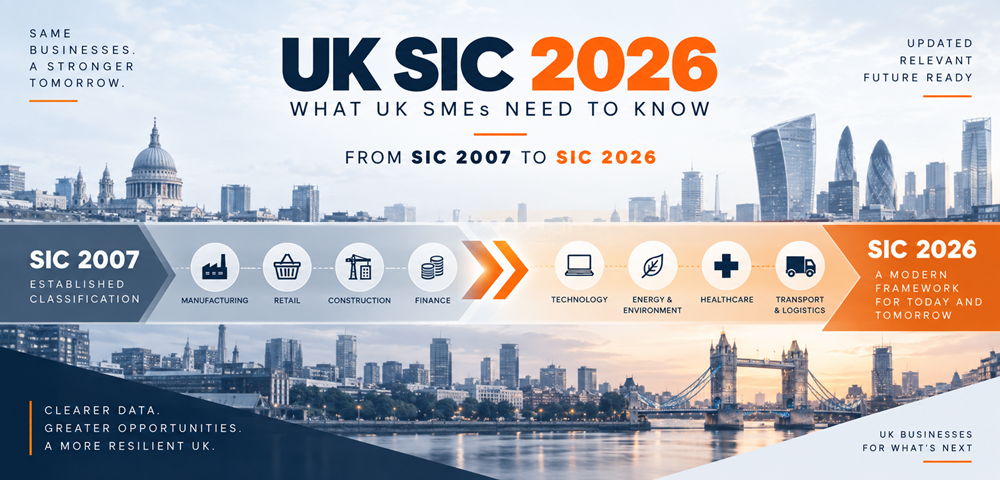
The UK’s Standard Industrial Classification has undergone its first major revision since SIC 2007. The new UK SIC 2026 framework was finalised in April 2026 and is intended to better reflect the way the modern UK economy operates.
For most SMEs, there is no need to make immediate changes. The Office for National Statistics (ONS) has confirmed that SIC 2026 is not yet in operational use across its systems, with the earliest anticipated use in the UK National Accounts currently expected in the 2031 Blue Book.
However, SIC codes are used for much more than official statistics. They also underpin market research, customer segmentation, prospecting and many commercial business databases.
For SMEs that rely on business data to understand or reach their markets, SIC 2026 is therefore worth understanding now.
What is a SIC code?
A Standard Industrial Classification, or SIC, code categorises a business according to its main economic activity.
The system provides a common way of grouping organisations carrying out similar activities. It is used by government and statistical bodies, but can also be used by commercial organisations as a practical way of classifying businesses.
For example, a supplier wanting to reach manufacturing companies might use SIC codes to identify relevant businesses. A technology company could use them to define a particular software or IT market.
For SMEs trying to identify a specific group of potential customers, that type of classification can be extremely useful.
Why has SIC changed?
SIC 2007 was developed almost two decades ago, and the economy has changed considerably since then.
Digital services have expanded, new technology-led activities have emerged, energy markets have evolved and the boundaries between sectors such as retail, communications, finance and technology have become less straightforward.
The ONS says SIC 2026 improves the representation of modern industrial activity while maintaining alignment with international classifications. Among the changes are more detailed classifications for software activities including artificial intelligence, wider coverage of energy-related activities and updates to financial-services classifications.
Why does SIC 2026 matter to SMEs?
For many smaller businesses, SIC codes may only come to mind when dealing with Companies House or other administrative information.
Commercially, however, they can be used in several ways.
Businesses may use industry classifications to:
- identify prospective customers;
- estimate the size of a target market;
- segment sales or CRM data;
- analyse existing customers by industry;
- identify suppliers and competitors;
- build more focused B2B marketing campaigns.
Changes to the classification can therefore affect which companies are included within a particular market segment.
If an SME regularly buys or uses business data based on SIC codes, understanding which version of the classification is being used will become increasingly important.
The change is not always as simple as replacing one code with another
Business Data Prospects, a UK B2B data provider that owns and maintains its business database in-house, has analysed SIC 2026 against SIC 2007 to understand how the changes could affect business classification, market segmentation and B2B targeting.
Our analysis identified changes across areas including manufacturing, energy, technology, retail, transport, healthcare and financial services.
One important point is that the transition cannot always be treated as a simple exercise of replacing one old code with one new code.
An existing category may be divided across several classifications. Activities may move between areas, and in some cases the relationship between an existing code and the activities it represents can change.
The ONS has therefore published an official correspondence table between SIC 2007 and SIC 2026 to help users understand how the two classifications relate to one another.
For SMEs, the practical lesson is simple: do not assume that two datasets containing apparently similar SIC information necessarily describe exactly the same business population.
Be careful when combining data from different sources
The transition could become particularly important when businesses combine information from several suppliers.
One dataset may eventually use SIC 2026 while another continues to use SIC 2007. A company’s own CRM may also contain historic classifications collected over many years.
If every field is simply labelled “SIC code”, differences between the frameworks could easily be overlooked.
Businesses that depend heavily on industry classification should therefore consider recording which version of SIC has been used.
That is a relatively small data-management step, but it could prevent significant confusion later.
SIC should not be the only way you define a target market
There is another useful lesson for SMEs.
A SIC code can be an effective starting point for defining a B2B audience, but it should rarely be the only criterion.
At Business Data Prospects, industry classification is used alongside information such as company location, employee numbers, turnover and the roles of individual decision-makers when creating B2B audiences.
That matters because two companies within exactly the same SIC classification can still be very different prospects.
A business employing five people and one employing 500 may operate in the same industry, but their purchasing needs, budgets and decision-making structures are likely to be very different.
For SMEs using business data for sales and marketing, combining industry information with other company characteristics can therefore produce a far more relevant audience.
What should SMEs do now?
Most UK SMEs do not need to start replacing SIC 2007 throughout their systems today.
The ONS itself says users do not need to take immediate action, although organisations may want to review the new classification and prepare for future implementation.
Businesses that regularly use SIC data can nevertheless take a few useful steps now:
- identify where SIC codes are stored or used;
- establish whether those codes are based on SIC 2007;
- review SIC 2026 changes affecting important customer or supplier sectors;
- ask data providers which version of SIC their datasets use;
- avoid mixing classifications without identifying them;
- review whether historic classifications still accurately describe businesses today.
That final point is important because businesses themselves change. Companies diversify, introduce new services or move into entirely different areas of activity.
As Business Data Prospects’ analysis of SIC 2026 shows, the transition is not simply about adopting a new list of numbers.
For SMEs, the immediate priority is awareness rather than migration. Businesses that understand how their market data is classified today will be better prepared when SIC 2026 begins to be adopted more widely.
Author Bio
Olivia Graham, Business Data Prospects
Olivia Graham works with Business Data Prospects, a UK B2B data provider established in 2007. Business Data Prospects owns and maintains an in-house database of UK companies and named business decision-makers, supporting organisations with B2B market research, segmentation and targeted business data.