
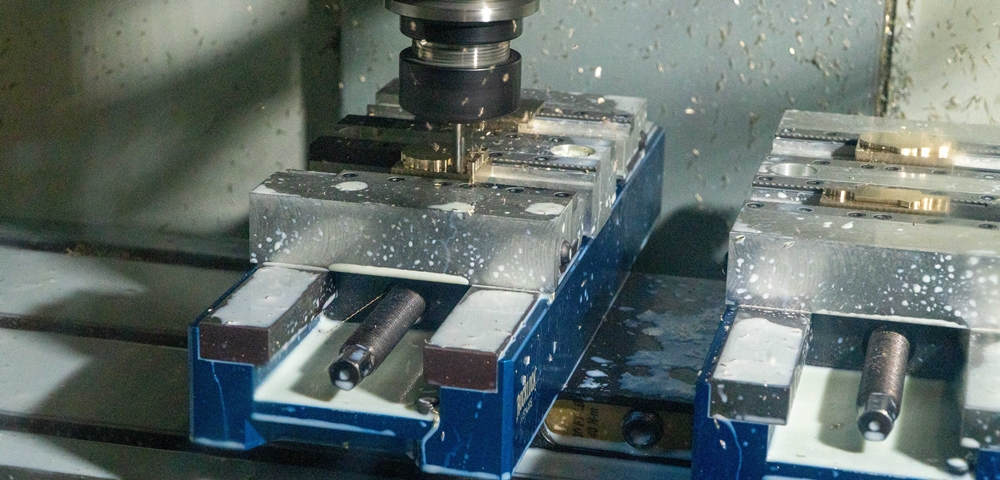
Running an ecommerce business sounds digital. When every order has to become a physical, one-off tool, the difficult bit starts after checkout. Michael Kelly, founder of Outpost Workshop, shares what he has learned from building a specialist manufacturing business around design, CNC machining and small quantities.
Most ecommerce businesses try to make their products as standard as possible. Mine does almost the opposite.
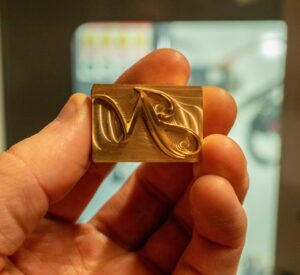 At Outpost Workshop, in Liverpool, I make custom brass branding irons and leather stamps for makers, small workshops and larger companies. Customers send a logo, a sketch or whatever artwork they have. I prepare it for manufacture, machine it into solid brass on a Haas CNC mill, then finish and dispatch the tool.
It sounds fairly straightforward written down. It isn’t.
Every order is different. A customer might send a vector file, a screenshot or a pencil sketch. The tool might be a tiny stamp or a larger branding iron, and the material changes what is possible. The machine is only one part of the business.
A better machine does not fix a messy process
I invested in professional CNC machinery because accuracy and repeatability matter. With small lettering, narrow gaps and detailed logos, a slight error can be visible in the final mark. The Haas gives me a level of control that would be difficult to achieve consistently with a more basic process.
But buying a better machine did not automatically create a better business. It exposed the weak parts around it. The order form, artwork, programming, fixtures, tooling, inspection and packing all need to connect. If one part is confused or slow, the machine spends a surprising amount of time waiting.
For another SME considering equipment, I would not only ask, ‘Can it make the product?’ I would ask how an order reaches it, how long setup takes and what is likely to stop it. The workflow pays for the machine, not the brochure specification.
Design and manufacturing belong together
My background is in graphic design as well as machining, and that combination has mattered more than I expected. A logo that looks excellent on a screen does not always become a good physical stamp. Hairline details can disappear, spaces can close up and a design that works in wood might need changing for leather or cork. Size matters too.
I do not expect customers to understand all of that. They should be able to send a clear image or rough sketch and let me work out the manufacturing side. Every design is checked before machining, and sometimes I spend longer adjusting a tiny gap in the artwork than the machine spends cutting it. There is a judgement call in it. Automating absolutely everything would make the service worse, not better.
Custom does not have to mean chaotic
Small-quantity custom manufacturing has a reputation for being slow and expensive because every order can be treated as a completely new job. The result can be unique while most of the production process stays repeatable. Stock sizes, fixtures, cutting strategies, tool libraries, file naming and inspection can all be standardised around the changing artwork.
That distinction between custom and chaotic is important. No two marks are the same, but I should not be inventing a new way to hold the brass or pack the tool every morning. Tightening up the repeatable parts has allowed us to aim for dispatch in one or two working days without making the product generic.
Owning production means owning the problems
The greatest advantage of in-house production is control. If I see an issue, I can change the artwork, alter the machining or remake a part immediately. I can answer a customer honestly because I am looking at the job rather than waiting for a supplier.
The other side is that there is nobody else to blame. If the machine stops, production stops. A broken tool, delayed material or unclear order lands on the same desk. I have learned to keep critical tools and material available, allow time for maintenance and avoid basing promises on the fastest day we have ever had.
I still get tempted to say yes too quickly because small business owners hate disappointing people. Usually, a realistic promise is better than an optimistic one you miss. Customers are often more understanding about a problem than they are about silence.
The website is part of the workshop
When a product is sold online, manufacturing starts before the machine is switched on. The website has to explain sizing, artwork, heating methods and what different materials can reproduce. If somebody expects a tiny, complicated design to leave a perfect mark in a material that cannot hold the detail, the problem began at the ordering stage.
Clear information, workshop photography and video set expectations and show that the product is actually made here. Good machining cannot rescue a confusing buying experience, so I now see the website as part of the production system, really.
Small manufacturers should make use of being small
A workshop like mine will not beat a factory producing thousands of identical units on the cost of each part. That is not the job. The advantage is making one item, dealing directly with the customer, making design decisions quickly and keeping the work traceable. One order might come from a leatherworker and the next from a recognised company, but both get the same care.
Small businesses sometimes apologise for being small. I think it can be their most useful feature. The customer speaks to the person preparing the artwork and often the person machining it. Design, manufacturing and customer service are only a few steps apart. That short feedback loop is hard to copy at scale.
Would I tell every SME to bring production in-house and buy machinery? No. Equipment has to solve a real customer problem. It should improve quality, shorten lead times, make a product viable or give the business control that is worth the capital and risk. Otherwise it is just an expensive object taking up floor space.
For me, the satisfying part is still the transformation. Somebody sends a mark that matters to them and, not long afterwards, it exists as a solid brass tool they can use for years. Growth has not been about removing human judgement. It has been about building something repeatable around it. The machinery helps, obviously, but the real advantage is how close the customer, designer and maker are. In my case they are often in the same conversation, and quite often the same person.