

Britain’s workplaces are getting lost in translation, with new research revealing that 61% of UK office workers have pretended to understand workplace jargon rather than admit they do not know what a colleague means.
The study of 2,000 UK office workers, commissioned by online printing company instantprint, explored how well different generations understand each other’s workplace vocabulary, from Gen Z favourites such as ‘rage applying’ and ‘coffee badging’ to office classics including ‘blue-sky thinking’ and getting your ‘ducks in a row’.
The findings reveal that 68% of workers regularly encounter workplace phrases they do not understand, with more than a third (36%) saying they would feel embarrassed asking someone from another generation to explain what a phrase means.
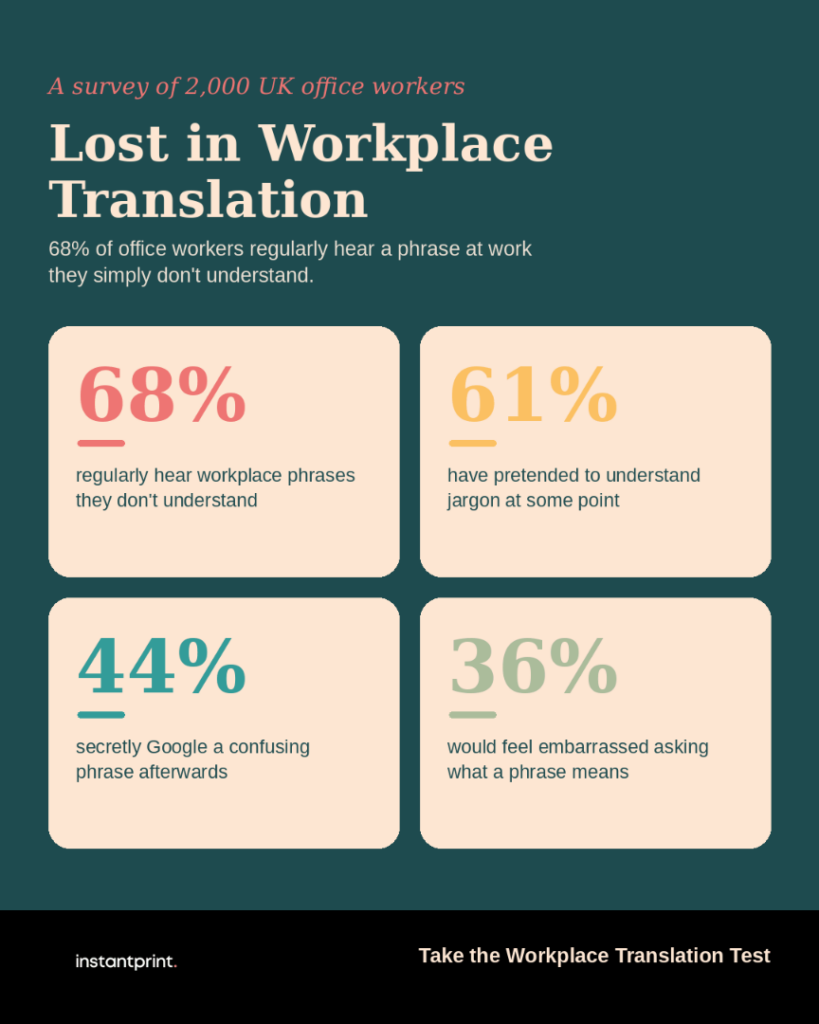 Instead, 44% admit to secretly Googling unfamiliar workplace terminology afterwards, 32% turn to a trusted colleague for a translation and 27% simply try to work out the meaning from context.
And while office jargon might seem harmless, the research suggests getting lost in translation can have genuine consequences. Almost one in five (18%) workers say unfamiliar workplace language has caused them to misunderstand an instruction, while 12% say it has contributed to them making a mistake at work.
Nearly a quarter (24%) have felt excluded from a workplace conversation because they did not understand the language being used, while 17% have avoided contributing to a meeting for the same reason.
Overall, 39% believe excessive jargon makes workplace communication less efficient and 35% think it can make workplaces feel less inclusive.
From ‘coffee badging’ to ‘boiling the ocean’, which generation speaks fluent office?
To put Britain’s workplace vocabulary to the test, instantprint asked different generations to translate popular phrases used by colleagues outside their own age group.
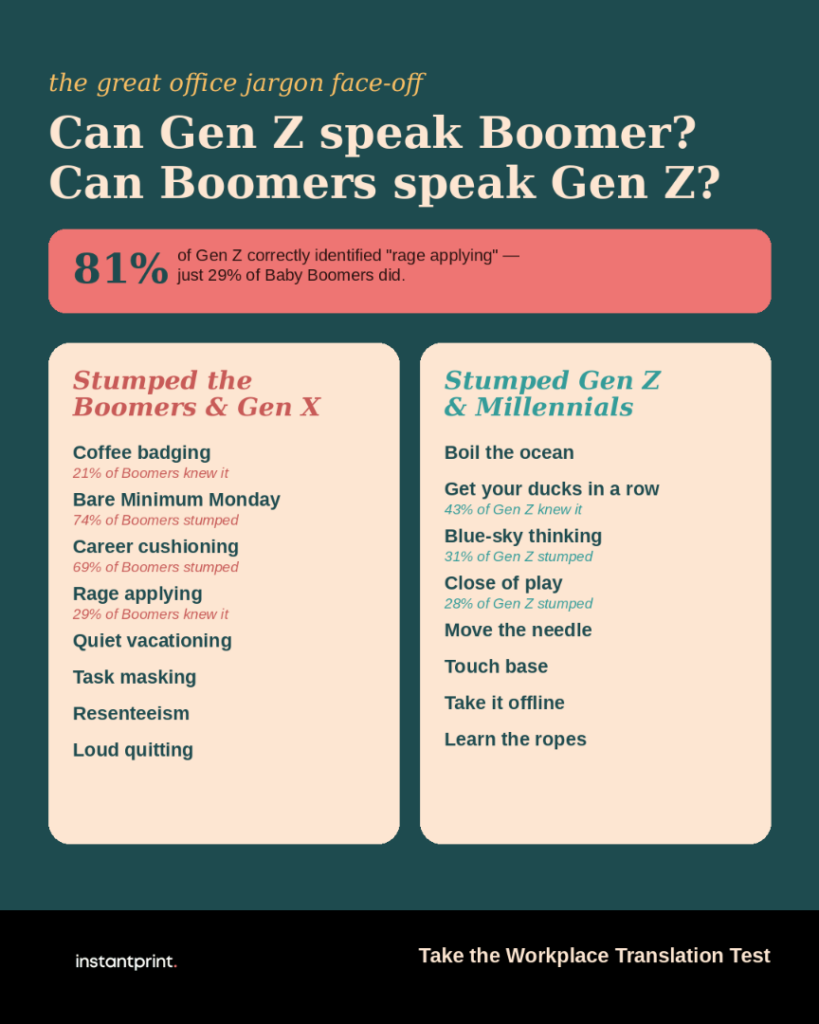
When it came to newer terminology, ‘rage applying’, the practice of applying for multiple jobs after becoming frustrated with your current role, was correctly identified by 81% of Gen Z workers, compared with just 29% of Baby Boomers.
‘Coffee badging’ proved even harder to decipher, with only 21% of Baby Boomers and 34% of Gen X workers correctly identifying its meaning.
Almost three quarters (74%) of Baby Boomers were stumped by ‘Bare Minimum Monday’, while 69% could not correctly identify ‘career cushioning’.
But younger workers should not get too smug just yet.
When Gen Z employees were challenged with more traditional office phrases, just 38% correctly understood ‘boil the ocean’, while fewer than half (43%) knew what it meant to get their ‘ducks in a row’.
Nearly a third (31%) could not correctly identify ‘blue-sky thinking’, while 28% struggled with ‘close of play’.
Across the translation test, Gen Z correctly identified an average of 5.9 out of 10 traditional workplace phrases, while Baby Boomers correctly identified an average of 4.2 out of 10 newer expressions.
We think we are fluent, but the results say otherwise
Despite the confusion, Britain’s office workers are surprisingly confident about their workplace vocabulary.
Before being tested, 72% rated their understanding of workplace language as ‘good’ or ‘very good’. However, when actually challenged to translate phrases from outside their own generation, the average employee correctly identified just 57%.
The research also found that each generation tends to believe its own vocabulary is easier to understand.
Almost three quarters (74%) of Gen Z respondents believe their generation’s workplace language is easy for everyone to follow, yet just 46% of workers aged 45 and over agree.
At the other end of the age spectrum, 69% of workers aged 55 and over believe traditional office idioms are easy to understand, compared with just 48% of Gen Z.
Your office vocabulary might be giving your age away
For anyone hoping to keep their age a mystery at work, their choice of words might be doing the revealing for them.
More than half (52%) of UK office workers say they can often guess a colleague’s age based purely on the language they use.
Phrases including ‘touch base’, ‘close of play’ and ‘move the needle’ were among those younger respondents most strongly associated with older colleagues, while ‘rage applying’, ‘quiet quitting’ and ‘it’s giving’ were viewed as giveaways for younger employees.
Workers are already adapting as a result. 58% say they deliberately change the language they use depending on the age of the colleague they are speaking to, rising to 67% among Gen Z respondents.
 ‘Let’s circle back’ tops the list of office phrases workers want gone
Despite the generational divide, there is one thing workers can agree on, some office phrases have outstayed their welcome.
More than two in five (42%) employees say there is at least one workplace expression they would happily ban forever.
‘Let’s circle back’ took the top spot, followed by ‘think outside the box’ and ‘touch base’.
The ten workplace phrases employees would most like to ban are:
- Let’s circle back
- Think outside the box
- Touch base
- It is what it is
- We’re like a family here
- Move the needle
- Quiet quitting
- It’s giving
- Blue-sky thinking
- Work hard, play hard
Clear communication matters, whatever generation you speak
Craig Wassell, Marketing Manager at instantprint, said: “It is easy to laugh at the differences between ‘coffee badging’ and ‘blue-sky thinking’, but our research shows there is a more serious side to the language we use at work. When people are pretending to understand what their colleagues mean, avoiding contributing to meetings or even misunderstanding instructions, jargon can quickly become a barrier to good communication.
“What is particularly interesting is that no generation has completely cracked it. Younger workers are just as likely to be confused by traditional office speak as older colleagues are by newer phrases, so it is less about one generation getting it wrong and more about recognising how quickly workplace language changes.
“For businesses, the takeaway is simple. Clear communication matters. Whether you are speaking to colleagues, customers or clients, the best message is one that people actually understand. A little less jargon and a little more clarity can go a long way.”
To accompany the research, instantprint has launched its Workplace Translation Test, allowing workers to put their office vocabulary to the test and discover how well they understand the phrases used across different generations.