

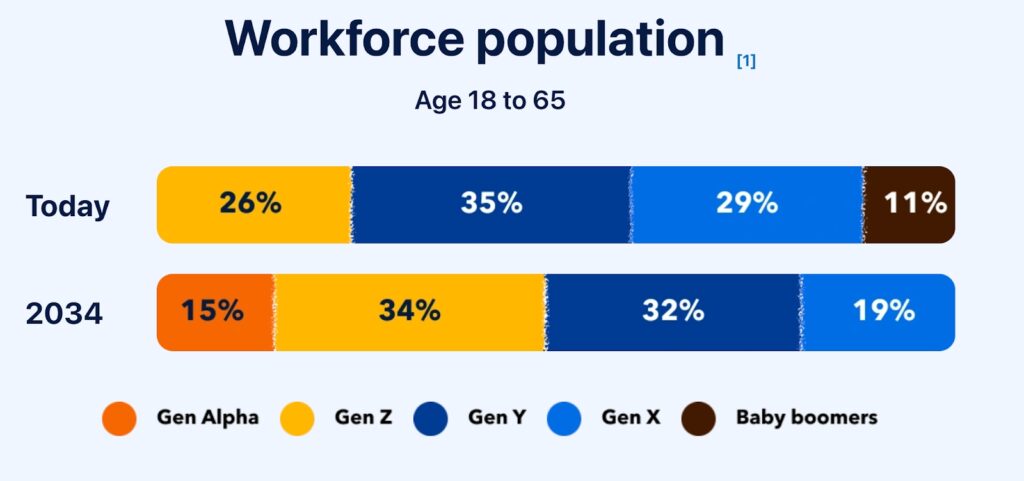
Gen Z and Alpha will make up almost half (49%) of the global workforce by 2034 – a significant demographic shift that will redefine the business landscape.
A new Booking.com for Business report has revealed what this shift will mean for businesses and their travel policies, with statistics showing that younger generations are key drivers of corporate travel.
You can view the full report here.
Gen Z leads the way
With Gen Z set to make up 34% of the global workforce by 2034 – the dominant portion – this group is having an impact on the workplace that can’t be ignored.1
Travel plays into Gen Z’s decision-making when selecting a job. In fact, over half (57%) say that a role that lets them experience other cultures is attractive, and 70% look forward to travelling for work.2 In regard to business trips, this generation wants to combine productivity with purpose and personal growth.3
Making online and mobile bookings is second nature to these true digital natives. They have a good level of comfort with using AI-powered travel services, and expect seamless bookings and personalised recommendations.4
What this means for your business travel programme:
- To meet work-life balance expectations, be transparent about travel frequency when hiring.
- Let employees benefit from loyalty programmes and ensure they can access 24/7 support through multiple channels.
- Offer an intuitive, consumer-grade travel booking tool to increase programme compliance.
Structured flexibility
Gen Z and Millennials rank workplace flexibility as the top reason for staying in a job, so it’s a good idea to consider what kind of ‘flexibility’ your company can introduce in regards to business travel.5
Many Gen Z workers are likely to extend business trips to enjoy leisure time too – a combination known as a ‘bleisure’ trip.6 So travel policies that facilitate better work-life balance are important.
Your business travel platform can also offer controlled flexibility if it gives your team the autonomy to book and manage their own work trips. They get the choice they want while helping you oversee and control costs.
What this means for your business travel programme:
- Offer remote work opportunities and the flexibility to extend business trips.
- Create a clear bleisure policy, so your travel arrangers and individual travellers understand what’s acceptable when booking and extending a trip.
- Use a business travel booking platform that offers a wide range of choices and lets you assign roles so travellers can arrange their own trips.
Joshua Wood, Director at Booking.com for Business, said: “We believe successful business travel combines consumer-level simplicity, ease, and rewards with financial discipline: Clear policies, flexible options, and technology that removes friction. When you design trips that respect employee time, company budget, and traveller wellbeing, you can transform business from a cost centre into a growth channel for generating revenue and building stronger teams. That’s the opportunity this trend report points to, and it’s within reach for every SME.”
1 Comment
Pingback: Die Zukunft der Geschäftsreise: Wie Gen Z und Alpha die Branche neu definieren