
Beyond the unit price: why scale, working capital, supply-chain risk and resilience matter when deciding where to produce
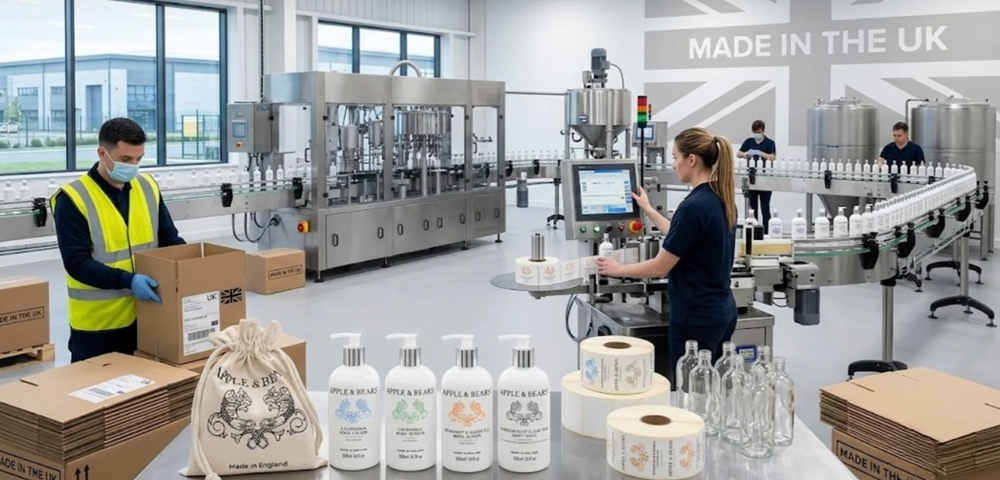
For an independent business, deciding where to manufacture is rarely a simple choice between producing in the UK or looking overseas for a lower production cost. The experience of APPLE & BEARS, an independent British beauty brand that manufactures its products in the UK, illustrates why the decision involves much more than the headline unit price. Production scale, minimum order quantities, quality, lead times, logistics, working capital, supply-chain resilience and the values a business wants its operational decisions to represent, all have to be considered. For a large manufacturer, the economics can be relatively straightforward: large production runs allow fixed manufacturing costs to be spread across substantial volumes, while purchasing power can secure more competitive pricing. For a smaller business, however, the same decisions can have a much greater impact on cash flow and financial risk. The question, therefore, is not simply whether something can be manufactured more cheaply overseas or locally in the UK, but where the overall balance between cost, quality, speed, resilience and control makes the most commercial sense.
The economics of scale and working capital
Scale represents one of the biggest challenges facing independent businesses. A factory production line requires machinery to be prepared, cleaned, calibrated and changed over regardless of whether the eventual run is relatively small or very large. Labour, energy and factory overheads must also be absorbed somewhere, which is why manufacturers can offer progressively better unit pricing as order volumes increase.
For some independent businesses, a UK manufacturer may specify a minimum production quantity of around 10,000 units for a single SKU. Increasing the order quantity can then produce a lower unit cost, with further economies potentially available as volumes increase. The experience of APPLE & BEARS, an independent British beauty brand, illustrates this dilemma: a production run of around 10,000 units can make manufacturing commercially viable, but it also commits significant working capital before those products are sold.
If products sell quickly, committing capital to larger runs can be highly successful. If demand is weaker than anticipated, however, the business is left carrying stagnant stock while waiting for that investment to convert back into cash. Crucially, every pound tied up in excess inventory is a pound that cannot simultaneously be deployed into marketing, product development, recruitment or expansion. For products affected by changing consumer demand, seasonal relevance or changing market conditions, excess stock becomes a major liability that cannot easily be solved by discounting below cost. The optimum production quantity is therefore rarely the volume that produces the lowest unit cost, but the quantity that balances manufacturing efficiency, expected demand and available working capital.
Scale applies to the product range too
The same principle applies beyond manufacturing volume and into product development. Large competitors may be able to support portfolios containing dozens or even hundreds of products, sizes and variations because their scale allows them to spread research and development, packaging, manufacturing preparation, marketing and distribution costs across a much larger business. An independent company may have to be far more selective. A smaller range does not necessarily represent a weaker business; it can allow a company to concentrate its limited resources on products that have genuine market relevance and commercial potential.
There is, however, a dilemma. Customers, retailers and distributors may expect a certain breadth of choice, while competitors may offer extensive portfolios. An independent business can therefore find itself maintaining SKUs that are important to the overall brand proposition even when one or two products significantly outperform the rest. The challenge is understanding the role of each product: some products generate volume, others may generate stronger margins, while some may attract customers who go on to purchase other products or contribute to the overall positioning of the brand. The objective is not necessarily to offer the largest range, but to offer a relevant range that the business can manufacture, finance, market and sell effectively.
Evaluating overseas manufacturing
Overseas manufacturing can offer significant cost advantages, particularly where production volumes are high and manufacturing ecosystems are well established. It would also be wrong to assume that overseas production automatically means inferior quality. Manufacturing capability has developed enormously across Asia, particularly in China, where investment in engineering, technology, automation and production capability has created highly sophisticated manufacturing industries. Quality should therefore not be treated as a simple geographical question. The right overseas supplier can produce to extremely high standards, just as a domestic supplier can produce poorly. The issue is the ability to identify, assess and manage the supply chain effectively. Nor should it be assumed that overseas manufacturing is always cheaper once the associated costs and risks are considered. The real comparison begins after the factory quotation.
The hidden cost of supply-chain risk
An approved sample can create confidence that a production run will meet the required specification, but a sample and a full production run are not necessarily the same thing. Independent businesses can find themselves in difficult situations when a larger shipment of components or finished goods does not perform to the standard expected from the approved sample. The financial commitment has already been made, goods may be in transit or already delivered, and production may depend on the component. Returning goods, replacing them or negotiating a remedy can consume valuable time and capital.
For instance, when a necessary component is unavailable locally, a business may approve an overseas sample, only to discover that a subsequent large production order fails quality standards. While a supplier might offer compensation through a discount on a future order, that does not resolve an immediate line shutdown. If the part is essential, the small business often has no choice but to source an alternative locally at a premium just to keep production moving. Supplier risk is an integral part of the true cost of manufacturing; a lower initial unit price quickly loses its appeal when balanced against rejected goods, production delays, replacement orders or unexpected freight costs.
Time is also a cost
Supply chains have become more complex for many UK businesses since Brexit, particularly where goods move between the UK and European markets. Customs procedures and additional administrative requirements can introduce delays and create greater uncertainty around lead times. For an independent company, time has a financial value. A supply route that might previously have allowed goods to be received, processed and dispatched within a matter of days can now require considerably more planning when cross-border procedures, customs clearance and potential delays are involved. A business may therefore need to hold additional stock simply to protect against less predictable supply routes, and that stock requires capital. A delayed component can stop production, a delayed finished product can affect a customer, and a missed delivery can damage a relationship. Consequently, the shortest supply chain is not always the cheapest, but the longest supply chain is not always the most economical either. The calculation needs to include the cost of uncertainty.
Why manufacture in the UK?
If overseas production can offer economies of scale, why would an independent British business choose to manufacture in the UK? For many firms, the answer is not simply cost; it is the combination of proximity, control, responsiveness and confidence in the supply chain. Manufacturing in the UK allows a business to remain closer to its manufacturing partners and to the production process. Communication can be more direct, problems can potentially be addressed more quickly, and there can be greater visibility over production. That proximity has a value which does not always appear on a manufacturing quotation. It does not mean UK manufacturing is always the most economical option; it means that the additional cost can, for some businesses, be justified by the advantages of being closer to production.
Manufacturing also has a social dimension
There is another consideration beyond the immediate commercial calculation. Choosing to manufacture locally can represent a wider social commitment: UK production supports employment and skills, contributing to the manufacturing communities in which businesses and suppliers operate. There can also be environmental considerations. Shorter supply routes may reduce some transportation requirements, although environmental performance cannot be judged simply by geography. Energy sources, production efficiency, materials and transportation all contribute to the overall footprint.
For some businesses, therefore, local manufacturing forms part of their values as well as their commercial strategy. This leads to a simple philosophy that can apply to independent manufacturing: manufacture where you are, where practical, and source globally where necessary. It does not mean believing every component or process must be sourced domestically. Modern manufacturing is global, and there will always be specialist components or capabilities that may not be available locally or may not make commercial sense to produce domestically. The objective is to look first at what can reasonably be produced close to home while recognising the value of international supply chains where they provide genuine capability, scale or economic advantage.
Understanding the true landed cost
Perhaps the most important calculation for an independent business is the difference between the factory price and the true landed cost. A realistic assessment may need to consider the manufacturing price, freight, customs and duties, inventory and warehousing, financing the stock, quality control, delays, replacement orders, currency exposure and the potential cost of lost sales.
The same principle applies to UK production. A higher manufacturing price does not automatically make it the wrong decision if shorter lead times, greater responsiveness, lower inventory requirements or stronger supplier relationships compensate elsewhere. The true cost is the cost of getting a product successfully from production to the customer—not simply the price paid to the manufacturer. This is where risk-adjusted thinking becomes important. A component sourced overseas may have a significantly lower unit cost, but if a quality issue delays production for several weeks, the financial consequence can be considerably greater than the original saving. Conversely, paying more for a local supplier may be commercially sensible if it reduces the probability or impact of disruption. Neither approach is automatically right; the business has to understand what it is paying for—and what risk it is accepting in return.
Finding the balance
For an independent business, there is rarely a perfect manufacturing solution. The appropriate approach depends on the product, production volume, available capital, expected demand, customer expectations and the level of supply-chain risk the company is prepared to accept. A business may manufacture some elements locally while sourcing others internationally. It may begin with smaller production runs and accept a higher unit cost while it establishes demand, before increasing volumes as sales become more predictable. Its manufacturing strategy may also evolve as the business grows. What makes sense for a startup producing a few thousand units may look very different once annual sales reach a much larger scale.
The important thing is not to confuse scale with success. Buying more because the unit cost is lower does not automatically create a better business. Carrying a larger range does not automatically create a stronger brand. Manufacturing overseas does not automatically produce a lower total cost. Manufacturing in the UK does not automatically produce a better commercial outcome. Every decision has a trade-off.
The independent manufacturer’s dilemma
This is ultimately why manufacturing is such a difficult decision for small businesses. They are competing against companies with considerably greater purchasing power, larger product portfolios, bigger marketing budgets and the ability to spread costs across much higher volumes. Yet an independent business can compete differently: it can be selective, concentrate its resources, respond to customers and develop close relationships with suppliers. The challenge is knowing where to use those advantages and where not to try to compete directly on scale.
The experience of independent British brands demonstrates this wider dilemma. Manufacturing in the UK can involve accepting higher costs in some areas, but those costs can be balanced against proximity, control, responsiveness, local economic contribution and confidence in the supply chain. That may not be the right balance for every business; it is an example of a wider principle that manufacturing decisions need to reflect the circumstances, resources and ambitions of the individual company.
There is no single manufacturing model
The future of manufacturing is unlikely to be simply UK versus overseas. Global supply chains will remain important. China and other Asian manufacturing economies will continue to play a major role, while other regions are developing their own manufacturing capabilities and skills. At the same time, local production will continue to have value where businesses need proximity, flexibility, specialist skills, shorter supply chains or want to make a wider social and economic commitment to their domestic manufacturing base.
For independent businesses, the most resilient model may therefore be neither completely local nor completely global—it may be selective. Manufacture locally where it makes commercial and strategic sense, source internationally where there is a genuine capability, scale or cost advantage, understand the risks of both, and continually reassess the balance as the business develops. Ultimately, the question is not simply, “Where can I manufacture this product most cheaply?” It is, “Where can I manufacture it in a way that allows my business to remain competitive, resilient, financially sustainable and capable of growing?” For an independent business, that is what UK manufacturing really means.
Author: Dean Butt
CEO & Co-founder, APPLE & BEARS