
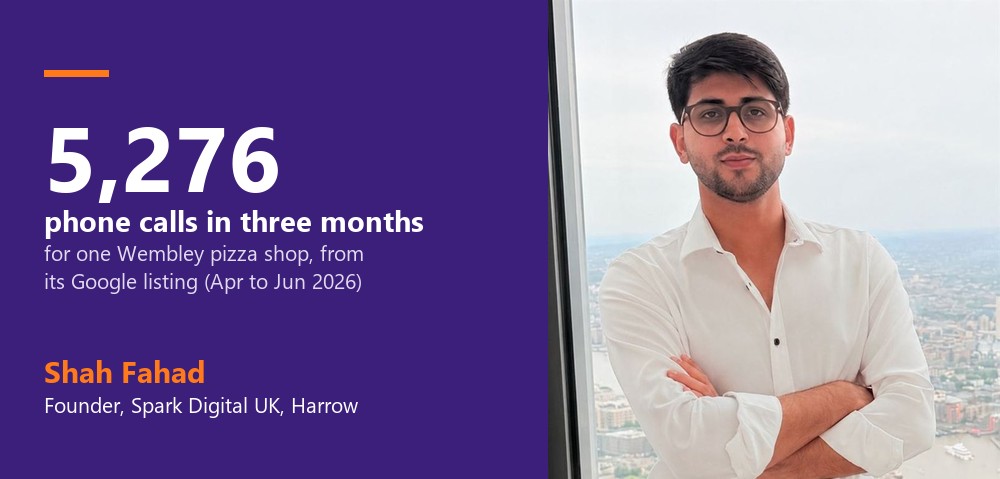

Shah Fahad started Spark Digital UK in Harrow in 2022. The agency helps independent local businesses across London get found on Google and Google Maps, with a small team of a web designer and developer, an SEO specialist and a graphic designer.
How did you start your business?
I kept seeing good local businesses lose customers over things that could be fixed. A half-finished Google listing. A slow website. Nobody checking what was actually bringing in calls.
Think about how you pick somewhere to eat now. You type “pizza near me” into your phone and decide in a few seconds, based on the hours, the photos, the star rating and a couple of recent reviews. If those details are wrong, the customer scrolls on, and the owner never even knows they were there. That bothered me. I knew how to fix it, so in 2022 I set up in Harrow and started doing it, beginning with restaurants, cafes and takeaways around Harrow, Wembley, Edgware and Hornsey.
How do you evaluate the ups and downs of your business?
With numbers, mostly. Google Business Profile Insights, Search Console and GA4 tell me what happened, and they don’t care how I feel about it.
The best up is easy to point to. Farmhouse Pizza in Wembley got 5,276 phone calls in three months, from April to June 2026, from its Google Business Profile, according to Google’s own data. Nothing clever produced that. We got the basics right and then kept them right, month after month.
The downs are humbling in a useful way. This September our own website’s database was rolled back to an older copy, and weeks of work disappeared from the live site overnight. We had it saved locally, so we rebuilt it. Lesson learned. It taught me to keep backups before touching anything, and I take that into client work now.
What is a typical day like for you?
Monday to Friday, nine to six, on paper. A normal day is a mix of Google Business Profile work, website fixes, replying to reviews and going through results.
There’s also a lot of talking to owners. Most of them are running a kitchen or a shop floor while we speak, so I keep it short. What changed? What did it bring in? What are we doing next?
What are the biggest challenges to being an entrepreneur?
Being a small business that sells to small businesses. My clients watch every pound, and they should. Everything we do runs month to month with no lock-in, so if the work stops paying for itself, they can leave. That’s uncomfortable. I still think it’s right, because it means the work has to keep earning its place.
The other challenge is deciding what to do next when you’re small. We began with restaurants because that’s what I knew. This year I opened up to other local businesses across London, and I don’t get to assume that what worked for a takeaway will work the same way for a tradesperson. We’ll have to prove it again.
What’s your definition of success?
The phone rings more than it did, and the owner can see why.
I’d take that over any award. I also count it as success when a family business beats a big chain on its own street, because the chain has a whole team doing this and the family has whoever is free after closing.
How do you win customers?
I start by looking at where they actually stand. We do a free audit before any quote, so the first conversation is about their listing, their calls and their competitors rather than about me.
Then I talk in plain English. Plenty of owners have been burned by someone who hid behind jargon and sent a report nobody could read. If I can’t explain a thing simply, I probably shouldn’t be charging for it.
What’s your most satisfying moment so far?
How do you build trust, with clients and with your team?
By being the person they actually deal with. There’s a team behind me, but every client still talks to me, and when someone gets in touch I reply myself.
With the team, it comes down to the same thing we promise clients, which is real details. The right opening hours. The real menu. Photos of the actual place, never stock pictures. When everyone knows the standard is “is this true and is it useful”, there’s less to argue about.
How do you plan on growing your business?
Carefully. The next step is taking what worked for restaurants to other local businesses across London, starting with the trades and the kind of emergency services people search for in a hurry.