
A manufacturing or engineering business can have excellent technical skills and still make life difficult for a prospective buyer.
That is a problem because B2B buyers often use a supplier’s website long before they speak to anyone. They may be checking whether the company works in their sector, whether it has solved a similar problem before, and whether there is enough evidence to justify an enquiry.
To see how UK engineering businesses handle this, Nebula reviewed the public websites of 100 engineering and manufacturing businesses listed in the Made in Britain Engineering directory in August 2026.
The aim was not to judge which company had the best-looking website. Instead, we checked for simple, visible signals that a buyer can use to understand relevance and reduce risk.
The findings point to a fairly basic issue. Many firms explain what they make very well. Fewer make it equally easy to see who they help, what they have achieved and why a buyer should contact them.
Sector relevance is still not always made explicit
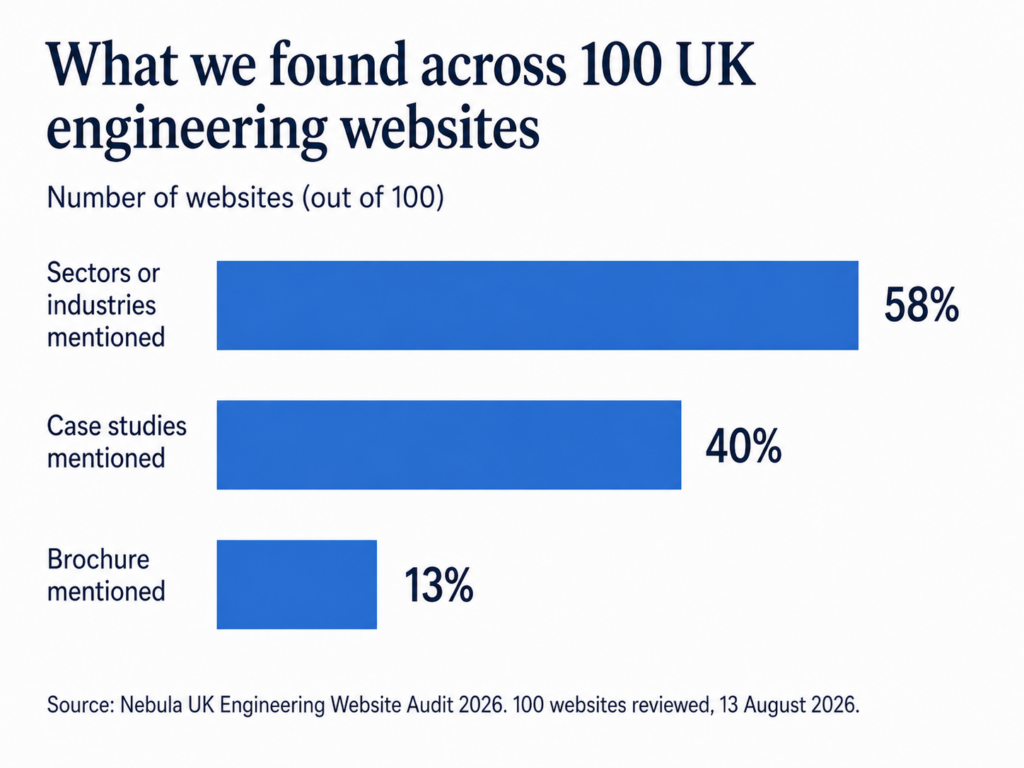
Of the 100 websites reviewed, 58 used explicit “sector” or “industries” language in their public page copy.
That means sector relevance was easy to identify on more than half of the sites, but it was not a consistent feature across the sample.
For an engineering SME, this matters because technical capability alone does not always answer the buyer’s first question: “Can this company do this for a business like mine?”
A precision engineering company, for example, may serve aerospace, medical, defence, automotive and specialist industrial customers. A page that explains applications, sector requirements and relevant capabilities gives a buyer more context than a long list of machinery.
This does not require creating dozens of pages. A smaller business can start with three or four priority markets and explain the problems it solves, the processes it uses and the type of work it can support in each one.
Proof is often less visible than capability
The clearest gap in our audit concerned case studies.
Only 40 of the 100 sites had a verified reference to “Case Studies” in the public text we reviewed.
That does not mean the remaining 60 firms have no successful projects. Nor does it mean that every case study we found was strong. The audit recorded whether the signal was present, not its quality.
But the result still matters.
Engineering businesses often hold their strongest marketing evidence inside the company. It may sit in project folders, sales conversations, quality documents or the experience of technical staff rather than on the website.
A useful case study does not need to reveal confidential information. It can explain the starting problem, the technical or production constraint, what the supplier did and the outcome.
Where commercial figures cannot be shared, firms can use other evidence such as lead-time improvements, reduced waste, a difficult tolerance achieved, a successful move from prototype to production, or a process made more reliable.
The website should help sales, not simply describe the company
We also tracked the word “brochure” as one narrow sign of downloadable sales material. It appeared on 13 of the 100 sites.
This figure needs care. Some companies may use catalogues, technical guides, datasheets, specifications or other downloads instead. Our check was deliberately narrow, so it should not be read as “87 companies have no sales material”.
The wider point is more useful. A website can support the sales process even when the visitor is not ready to send an enquiry.
A technical guide, capability sheet, product selector, application note or short buyer guide can give a prospect something useful to take away. It can also give sales teams a relevant asset to send after a first conversation.
What should an engineering SME change first?
There is no need to rebuild an entire website simply because it does not contain every marketing feature.
Start with the buyer’s basic questions.
Can they understand within a few moments what you do? Can they tell whether you work with their sector or application? Can they see evidence from comparable work? Is there a clear next action? Can they take away something useful if they are researching rather than buying today?
For many firms, improving those answers may be more valuable than adding more general company copy.
The strongest technical businesses already have much of the material needed. The task is to turn internal knowledge, completed work and sales experience into public evidence that a buyer can understand.
That is especially important for SMEs. A smaller supplier may not have the brand recognition of a major group, so its website has to do more of the early trust-building work.
Research methodology
Nebula reviewed 100 accessible public websites drawn in directory order from the Made in Britain Engineering category on 13 August 2026. The full methodology and research data are available in the Nebula UK Engineering Website Audit 2026.
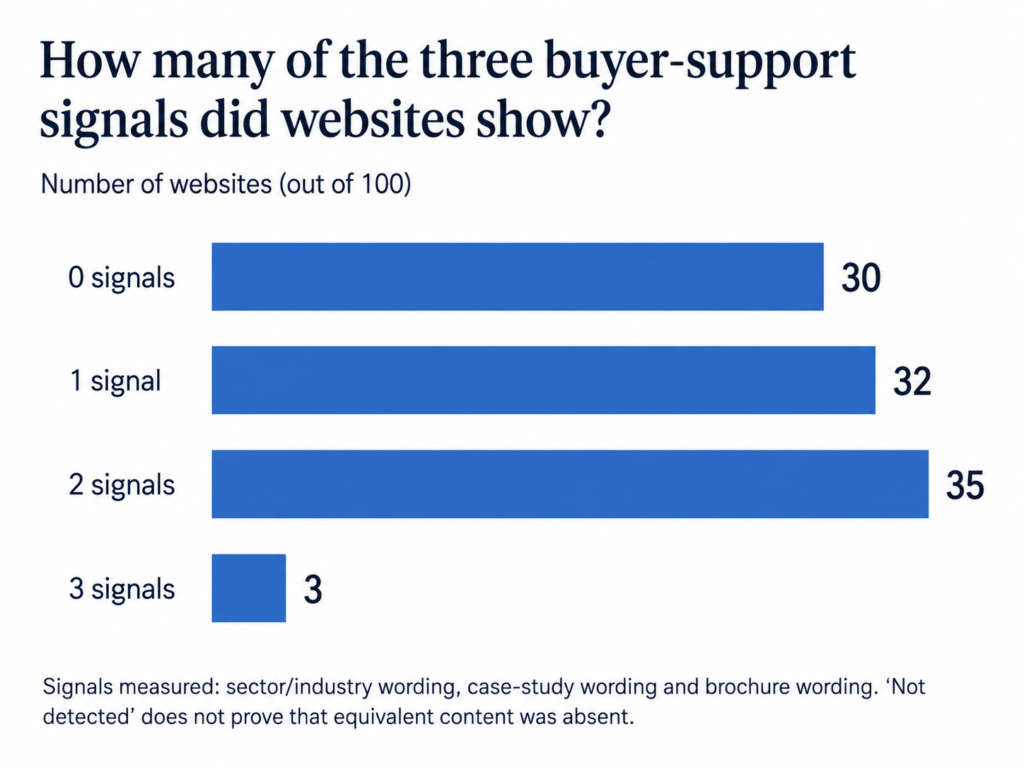
We used fixed text checks for three signals: the phrase “Case Studies”, the terms “Sectors” or “Industries”, and the word “Brochure”. “Not detected” means the term was not found in the standard public-site check. It does not prove that a feature or asset does not exist.
The sample is a benchmark of this defined group, not a statistically representative survey of all UK manufacturers or all UK SMEs. Website content can also change after the audit date.
About the author
Carol Whitmore, is Head of Research at Nebula Marketing Consultancy, a UK-based company working with technical, engineering and B2B SMEs. Nebula supports businesses with marketing strategy, content, lead generation and sales support.
Website: https://www.nebulas.uk/