
For years, small businesses have monitored Google rankings, customer reviews and local search visibility. Those measures remain important, but another route to discovery is emerging.
Instead of searching through a page of links, a prospective customer may ask ChatGPT, Google Gemini or Anthropic Claude a direct question:
“Which local business should I choose?”
This changes the customer journey. The AI assistant may create a shortlist, compare suppliers or recommend one business before the customer has visited any of their websites.
UK SMEs should not abandon established marketing in response. However, they should begin considering whether AI assistants understand their businesses well enough to include them in relevant recommendations.
AI recommendations are not conventional rankings
A Google results page normally provides an observable list of links. AI-generated answers behave differently.
Responses can vary between providers. They may also change according to location, wording, available web access and when the question is asked. One assistant may name several businesses, another may recommend a single supplier, and a third may provide general advice without naming anyone.
For this reason, describing AI visibility as a fixed “ranking” can be misleading. There may be no permanent first position to track.
A more useful starting point is recommendation coverage: across a consistent collection of realistic customer questions, how frequently is the business included when the AI actually selects or compares suppliers?
Why naming the business can distort the test
Some visibility checks place the company’s name directly inside the prompt:
“What can you tell me about Example Company?”
A detailed response may look encouraging, but it proves only that the AI can describe the company after being explicitly asked about it. It does not establish whether the assistant would independently recommend that business to a prospective customer.
A more revealing test begins with unnamed questions reflecting genuine buying intentions. Examples might concern finding a trusted local supplier, comparing alternatives, assessing value or choosing a provider for a particular requirement.
Only after those answers have been collected should the analysis determine whether the target business appeared.
This blind-first approach is closer to the situation businesses are trying to understand: what happens when the customer knows what they need but has not yet chosen a supplier?
Not every missing mention is a lost recommendation
The distinction between informational and commercial answers is equally important.
Suppose an AI assistant is asked how to choose a reliable accountant. It may respond with a checklist covering qualifications, reviews and fees without naming any firm.
That should not automatically be recorded as the target accountant losing to a competitor. No supplier was selected.
Useful measurement should distinguish among:
- The target business being recommended
- A competitor being recommended
- Several suppliers being compared
- A general answer in which no supplier was selected
Without this separation, reports can exaggerate poor performance by treating every absence as a competitive loss.
The existing fundamentals still matter
Businesses do not need to chase mysterious “AI optimisation tricks.”
Many of the signals that help people understand and trust a business are also likely to help AI systems interpret it accurately. These include:
- Clear descriptions of services and intended customers
- Accurate location and service-area information
- Consistent business names, addresses and telephone details
- Appropriate structured website data
- Recent, detailed customer reviews
- Transparent pricing or explanations of value
- Credible mentions from trade organisations, local media and respected industry sources
- Useful content answering genuine customer questions
If a competitor is repeatedly recommended, the important question is not simply how to insert more keywords. It is what accessible evidence supports that competitor’s suitability and whether the target business communicates equivalent strengths clearly.
Establish a baseline rather than chasing certainty
An individual AI response is not proof of a permanent position. A structured collection of responses can nevertheless provide a useful baseline.
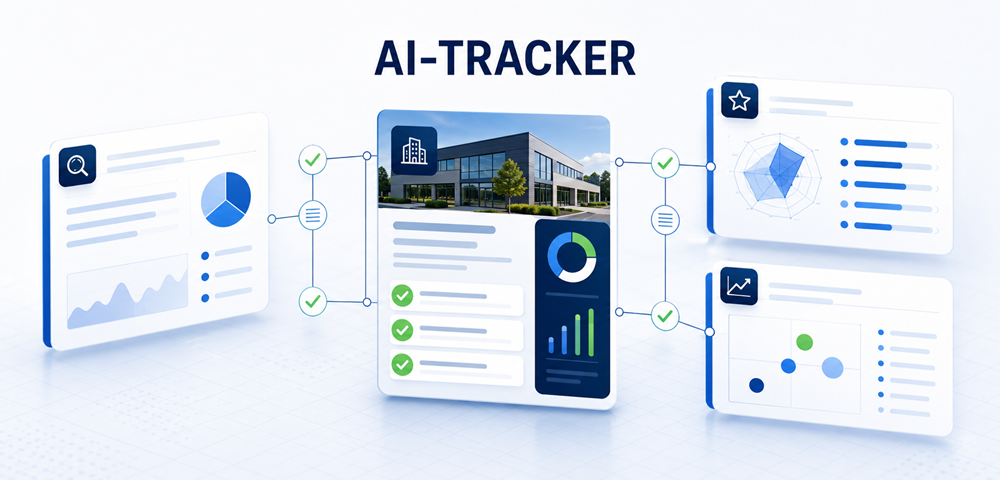
I developed AI‑Tracker to apply this principle. It creates 20 customer-style questions based on a business, its industry and its location without initially naming the company. The questions are tested independently across ChatGPT, Gemini and Claude, producing 60 measured responses.
The resulting report separates genuine supplier-selection answers from general information, records competitors and first-position recommendations, compares providers and identifies practical priorities.
The purpose is not to claim that AI answers never change. It is to measure a defined sample transparently and repeat the process later under comparable conditions.
Repeated scans become more valuable than an isolated result because they can show whether recommendation coverage is improving, declining or remaining unchanged.
Connect measurement with actual enquiries
SMEs should also update their customer-attribution processes.
A simple “How did you hear about us?” field could include:
- Google or another search engine
- Recommendation from another person
- Social media
- ChatGPT or another AI assistant
- Other
Customers may still write “online” when an AI assistant influenced them, but recording this option provides a practical way to observe the trend.
Over time, businesses can compare genuine enquiries with measured recommendation visibility. This is more useful than relying entirely on assumptions about changing customer behaviour.
An additional signal—not an SEO replacement
AI recommendation monitoring is still developing. It should currently be treated as an early-warning and business-intelligence measure alongside search performance, reviews and direct customer feedback.
The businesses that start measuring now will not obtain perfect certainty. They will, however, establish something valuable: a documented baseline showing whether major AI assistants currently include them when potential customers ask who to choose.
As customer discovery changes, knowing that baseline may prove considerably more useful than discovering years later that competitors became the default recommendations.
AI‑Tracker is available at https://getaitracker.com.