
By Tyson Gunderson, co-founder of Bureau
The global office fitout market is worth $65 billion today, projected to hit $100 billion by 2030. With 65% of organisations planning to increase spend on workplace design in the next five years, the question isn’t whether businesses will invest in their offices. It’s whether they’ll do it the old way or adopt a more flexible, efficient model built for how people work in today’s environment.
Right now, the old way is failing. Office workers are interrupted or switch tasks every three minutes, and it can take up to 23 minutes to fully regain focus. In a year, that adds up to 127 hours of lost productivity per worker, just from distractions. 36% of employees cite face-to-face interruptions as the biggest culprit, with a further 25% caused background noise. And yet 70% of offices are still open plan.
The problem runs deeper than distraction, with approximately 15-20% of adults estimated to be neurodivergent, the modern workforce is far more varied than the environments designed to house it. No two people are the same yet the expectation to show up, sit in the same open space, and get on with it, remains. When the environment doesn’t support how people actually work, productivity, efficiency and revenue all take the hit.
Different tasks demand different environments. Focused work needs quiet. Collaboration requires energy and space. Calls need privacy. The idea that a single open-plan layout can support all of this simply doesn’t hold anymore. According to the Hybrid Occupancy Index, 42% of employees say their workplace isn’t set up to support hybrid working which is still built around a 9-5 model that most organisations have long moved away from.
Offices are no longer static environments. They’re tools, and like any tool, they need to evolve alongside the organisation using them.
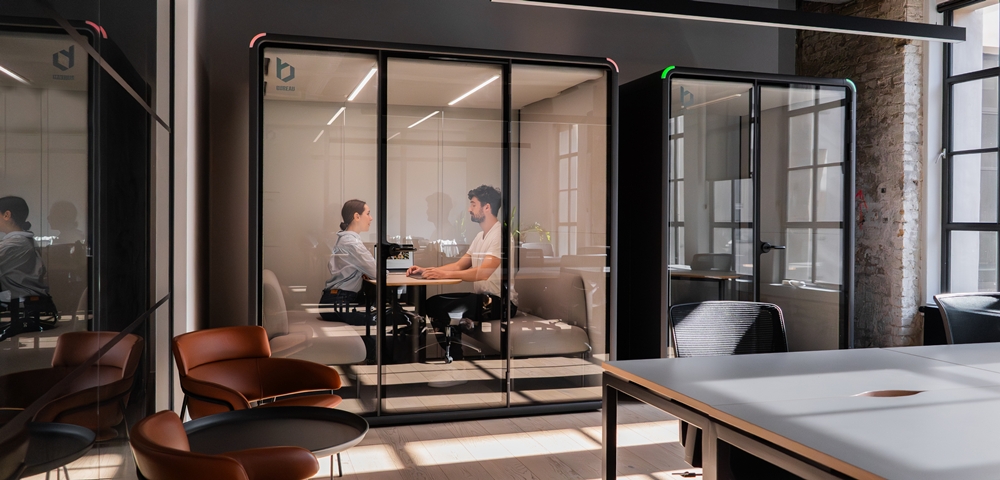
That is why we are seeing the demand for a different model emerging. Rather than redesigning entire offices, businesses are wanting modular, self-contained spaces that can be installed without construction: environments shaped around specific tasks, whether deep work, private calls or small-team collaboration. Workspace design is becoming more deliberate, and the economics make a compelling case. Modular booths are 50% faster to install than a traditional build, produce 45% less CO2, and in many cases cost over 50% less than building a fixed meeting room.
Companies like Bureau are part of that shift, offering soundproof and tailored booths that are simply integrated into existing office layouts without the disruption or cost of traditional fitouts, creating quiet, controlled spaces where people can focus. Bureau’s latest Signature Series 2.0 delivers around 30dB noise reduction, creating genuinely quiet environments within busy offices. Combined with controlled lighting and low-noise ventilation, they offer the kind of consistent, distraction-free space that modern work increasingly demands.
In March 2026, Bureau became the world’s first soundproof booth company to receive the ‘Works with WELL’ trademark licence from the International WELL Building Institute – independent validation of its air quality and environmental standard. A reflection of the standard and seriousness in creating flexible spaces for ‘humans’ and not just ‘employees’.
The mismatch between how offices are designed and how people work is becoming harder to ignore. The businesses that close that gap first won’t just have happier teams, they’ll have a measurable advantage.