
New research has revealed how the £2.3 billion trade deal with China could significantly boost China’s position among the UK’s top export markets.(1)
According to the latest ONS figures, China currently ranks seventh among the UK’s biggest export partners, after major players including the US, Germany, Netherlands, and other EU countries. (2)
China is currently Scotch whisky’s 10th largest market but this deal, including a cut in tariffs to 5%, could strengthen exports of this and other commodities even further.1
The business finance experts at money.co.uk business credit cards have analysed today’s ONS data release to reveal the current state of UK exports.2
Top countries that UK businesses are exporting to:
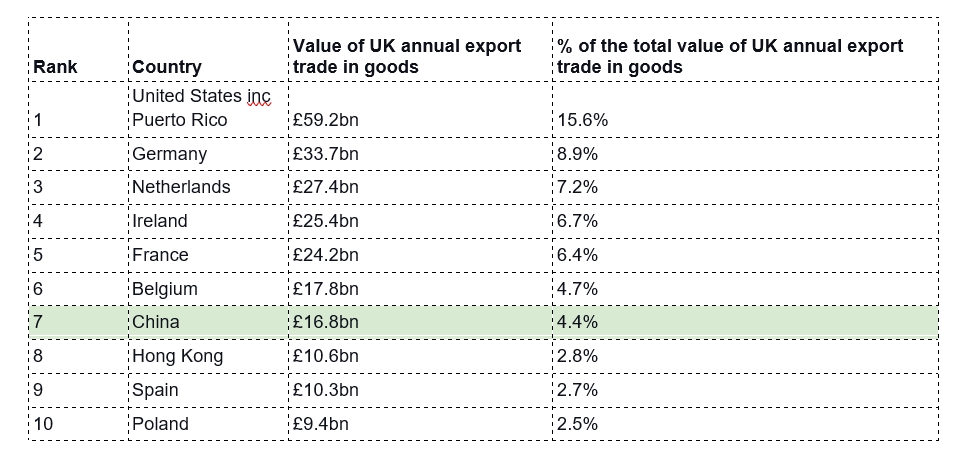
The United States remains the UK’s top export destination. ONS figures show that the UK exports £59.2 billion in goods to the US in a year – over 15% of its total exports. However, recent tariff changes have made US trade more complex. These shifting rules may push UK exporters toward more stable and accessible international markets.
Germany is the UK’s second-largest export partner, receiving £33.7 billion in goods. Despite friction caused by Brexit, Germany remains a vital gateway to Europe. It continues to be a strong market for British manufacturing, especially vehicles, pharmaceuticals, and machinery.(3 )
The Netherlands ranks close behind, with £27.4 billion in UK exports – about 7.6% of the total. The Port of Rotterdam, one of Europe’s largest, makes the Netherlands a key logistics and distribution hub. The Netherlands is a strategic and stable option for UK businesses looking to maintain strong European trade while avoiding customs delays.
Joe Phelan, money.co.uk business credit cards expert, comments: “Global trade is constantly evolving, with new challenges and opportunities emerging all the time. For exporters, the key to success lies in staying flexible and adaptable, whether that means exploring new markets, diversifying product lines, or adjusting supply chains.
“However, exporting introduces a unique set of financial pressures, from delayed payments due to lengthy shipping timelines to costs like duties, tariffs, and currency fluctuations. For SMEs navigating international trade, managing cash flow becomes more complex and crucial. That’s why having the right financial tools, like business credit cards, can provide the agility and resilience companies need to navigate uncertainty and continue growing.
“A well-chosen business credit card can help to bridge these payment gaps. You can still cover the upfront costs like paying workers and unexpected freight or duty charges without negatively impacting cash flow. The interest-free period can give you breathing space while waiting for international earnings to come in.”
Sources: