
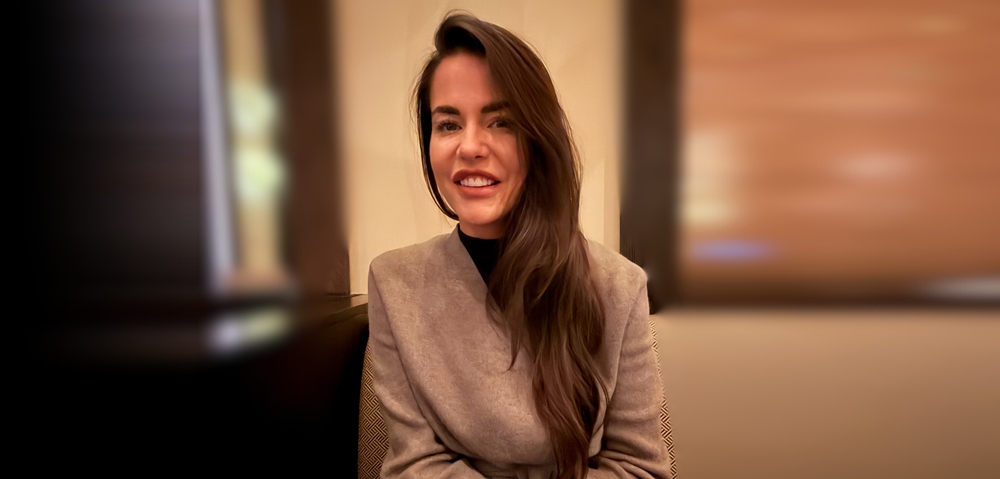
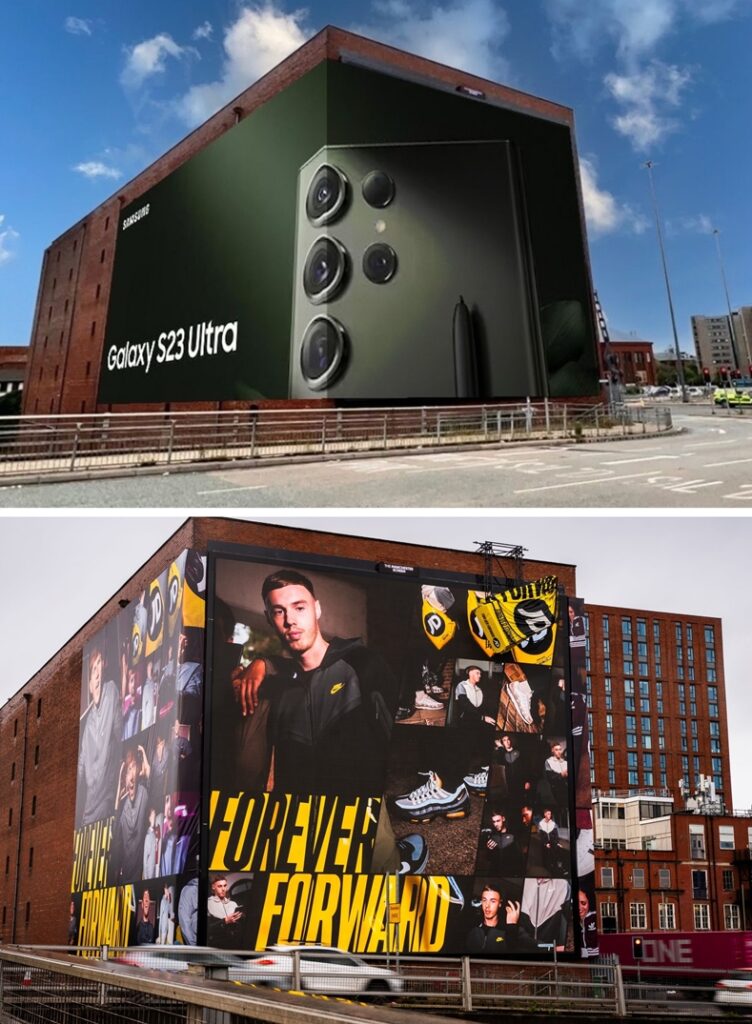
 As the owner of The Manchester Screen, now the second-largest digital billboard in Europe and arguably the most impactful combined static-and-digital site in the UK, Katie Smith is one of the few independent operators transforming regional OOH into a national talking point.
Katie talks to SME Today and comments on 2026 industry trends, the rise of experiential, and why her “Beyond the Billboard” approach is redefining what OOH can be.
Q: You’ve taken full ownership of The Manchester Screen this year. What does 2026 look like for you and for the site?
2026 is about scale, creativity and smarter integration. The Manchester Screen has grown into a genuine destination for brands – not just a placement – and next year is about pushing that even further with new creative technologies, partnerships and data-led approaches.
We’re already seeing a surge in demand for landmark OOH outside London, especially from brands that want cultural relevance without the noise and saturation of the capital. Manchester’s audience is incredibly responsive, incredibly social, and far more diverse than people give it credit for. That combination is gold for marketers – and 2026 will only amplify that.
We’re also developing new ways for brands to measure cultural impact, not just impressions.
In short, our ambition is simple: make The Manchester Screen the UK’s most creative, culturally relevant, audience-loved OOH destination.
Q: You’re often cited as one of the only female owners of a major independent OOH operation in the UK. How does that shape your perspective?
It’s definitely unusual. Outdoor media at the large-format end is still heavily male-dominated, especially when you’re talking about ownership rather than sales or operations.
But being the outlier gives me freedom. I can run The Manchester Screen without the legacy systems or corporate constraints that often slow bigger operators down. I make decisions quickly, I work directly with agencies and brands, and I lead with creativity rather than structure.
I want my presence in this space to make it easier for more women to enter at senior, strategic and ownership levels – not just sales roles. Representation matters, especially in an industry that shapes public spaces.
Q: What industry trends are you keeping a close eye on as we move into 2026?
Three things stand out:
1. Omnichannel OOH is no longer optional.
Billboards don’t exist in isolation anymore. They’re part of a wider content ecosystem where social, search, experiential and retail activation sit alongside outdoor. The strongest campaigns we run are the ones that treat OOH as the starting point for a wider conversation, not the final placement.
A great couple of examples of this are the impact that recent campaigns have delivered. For Southern Comfort, a social media post featuring Aitch (now of I’m a Celebrity fame) drove 2947% more engagement than any previous posts. It was a similar story for the Feel Good Club, which utilises the screen to promote relevant messaging at time sensitive moments, with one post achieving 2.2 million views and over 20k shares.
2. Experiential is exploding.
Brands want presence and participation. Big screens alone aren’t enough – they need to spark behaviour, engagement, something people want to photograph or talk about. That’s why The Manchester Screen has evolved into a canvas for builds, projections, murals, rooftop activations — not just a rectangle with pixels.
3. Real creativity is back.
Marketers are tired of safe campaigns. They want bold. They want fun. They want “you need to go and see that”. Manchester is perfect for this because the audience genuinely loves seeing itself reflected on big cultural moments.
Q: You’ve developed “Beyond the Billboard”. What does it mean – and why does it matter to advertisers?
Beyond the Billboard is the strategic layer that elevates the site from an OOH placement to a social and experiential engine.
Most people still think in terms of “reach”, “OTS” and “impressions” when it comes to DOOH. Those metrics matter – but we’ve proven that the cultural impact of the screen goes much further. We’re thinking past the billboard and what the space allows for, including pop up activations on rooftops, which gain millions of impressions because of the guerilla and strategic omnichannel planning.
When a celebrity or influencer posts in front of The Manchester Screen, like Aitch or Molly-Mae, the content performs off the charts. We regularly see hundreds of thousands of extra views and engagements because the screen becomes part of the story. It’s instantly recognisable, it’s associated with Manchester culture, and it visually elevates whatever’s being promoted.
That’s the essence of Beyond the Billboard – it’s a bigger social canvas. A moment. The physical format drives digital performance and, in an omnichannel world, those two things shouldn’t be separated.
Q: Manchester is increasingly described as a creative testbed for OOH. Why do you think the city works so well?
It’s the mix of audience, energy and identity.
Manchester has a huge student population, a thriving gaming and music culture, world-class sport, and a city centre that people actually walk through. The behaviour is perfect for OOH – people interact with public space here in a way that’s very different to London.
Brands see Manchester as a place where they can trial big ideas without being drowned out. When something works here, it works everywhere.
The Manchester Screen sits at a cultural crossroads – between MediaCity, city centre, and match-day traffic and music events – so the audience is broad, diverse and constantly shifting. That’s a dream for testing creative relevance.
Q: Experiential OOH is one of your big focus areas. How does the screen fit into that movement?
The screen is the anchor – the landmark that provides visibility, credibility and scale. But experiential brings it to life.
We’ve done campaigns with live builds, real-time social integration, gamified content, AR overlays and creative takeovers. What I’m seeing now is a move towards hybrid experiences:
- Social-first creative that comes alive on the big screen
- Real-time community or fan reactions
- Pop-up builds and rooftop activations
- Murals and projections as part of the same campaign ecosystem
Outdoor used to be one-dimensional. Now it’s a toolbox for brand worlds.
Q: What challenges – or freedoms – come with operating outside the big-operator ecosystem?
The biggest challenge is education. Agencies often default to the big operators because it’s easier administratively, not because it’s better creatively.
But the freedom is enormous. I can move fast. I can approve bold ideas without five layers of sign-off. I can collaborate with creatives directly. I can experiment. Independents are where the innovation happens. Big operators deliver scale; we deliver possibility.
Q: And finally – can you share any exciting upcoming campaigns for The Manchester Screen?
All I can really divulge at the moment is that we’ve got some really exciting partnerships coming up! We’re going to be doing some highly targeted campaigns based on real-time trends and regional consumer insight. This is hugely exciting as we continue to test and learn, using the latest AI technologies and data. There will also be new motion capability and some live streaming with one of our newest partners.
I’m committed to continuing our work with Feel Good Club into 2026. For me, using The Manchester Screen to amplify positive mental-health messages is one of the most meaningful parts of what I do. Not every organisation has access to a platform of this scale, and when we put their campaigns up, you can see the impact almost instantly — the conversations online, the messages from people who felt seen. It’s a reminder that independent media owners can drive real social value.