
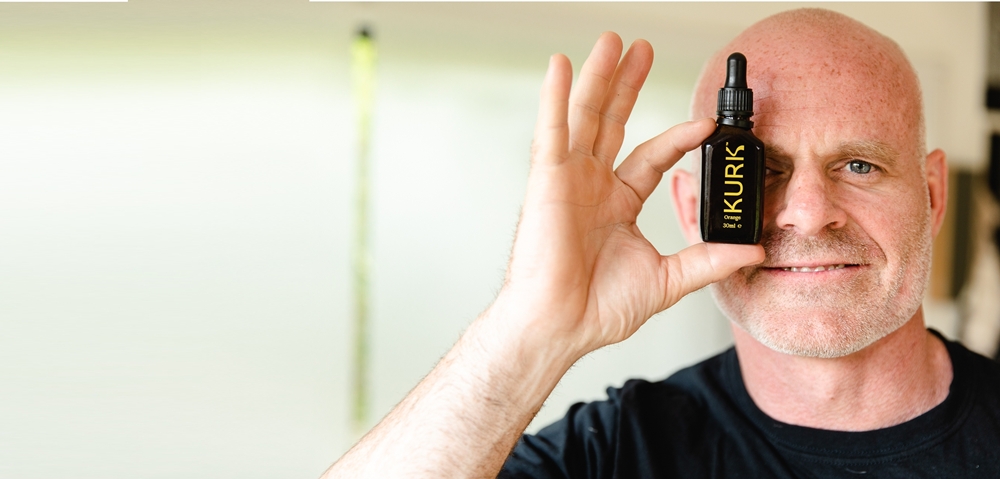
Trent Scanlen, CEO and co-founder of KURK, on why backing homegrown entrepreneurs matters more than ever
KURK is one of the UK’s fastest growing UK pharma-wellness ventures, on a mission to redefine conventional approaches to pain management, inflammation and recovery.
Founded in Twickenham in 2022 by Trent Scanlen and Dr Harrison “Harry” Weisinger – two long-time friends and cancer survivors – KURK has since grown well beyond its London beginnings. For co-founder Trent, KURK’s success story is proof of a how growing interest in plant-based wellness and preventative health is fuelling demand, and why supporting UK startups is crucial for building a resilient, British-led wellness and biotech ecosystem.
Can you walk us through your career journey – how did KURK begin?
Most supplement companies start with a marketing idea and work backwards to find a product. We did the opposite.
After my lymphoma diagnosis in 2012, I became obsessed with understanding inflammation at a molecular level. Not wellness trends, but actual biology. My closest friend, Dr Harry Weisinger, had spent decades studying nutrition and human physiology, and had lived through serious illness himself including Crohn’s disease and lymphoma.
What started as two friends trying to understand their own bodies became a four-year research project in our Twickenham lab. We weren’t trying to launch a brand. We were trying to solve a problem: curcumin has extraordinary anti-inflammatory properties, but the human body can barely absorb it. That gap between promise and delivery interested us enough to build a company around fixing it.
What separates KURK from other companies?
Here’s something most people don’t realise: roughly 95% of supplement brands don’t make anything. They buy generic formulas from contract manufacturers and put their label on it. Same product, different packaging.
KURK is fully vertically integrated. We developed our own micelle-based delivery system – which took four years – and we control every step from formulation to manufacturing to testing. Our curcumin achieves 185 times better bioavailability than standard supplements. That’s not marketing; that’s measurable in blood plasma.
We’re the only curcumin company I’m aware of with an Innovate UK grant and an active research partnership with a UK medical school.
What separates us is that we’re not a marketing company with a supply chain, we’re a biotech company with a consumer brand. Every formulation is designed in-house, manufactured under our control, and validated through real-world data. That’s why our customer conversion and retention rates lead the industry.
How important are partnerships in helping your business grow?
When you’re a small company making big scientific claims, partnerships aren’t optional – they’re your proof.
Our collaboration with Swansea Medical School, backed by an Innovate UK grant, isn’t just about research. It’s about demonstrating that our technology stands up to academic scrutiny. We’re also in discussions with institutions in Australia and the US to expand that validation internationally.
What major challenges have you faced as a business and how have you overcome these?
The biggest challenge has been navigating regulation while staying true to our science.
The UK and EU have strict rules about what health claims you can make for supplements, and rightly so. But it creates a paradox: we have genuine clinical research supporting our product’s efficacy, yet we’re limited in how directly we can communicate that.
Our solution has been to let the science speak for itself. We publish our research. We partner with medical schools. We let customers experience the results. It’s slower than just making bold marketing claims, but it builds something more durable.
What is next for KURK?
Our mission hasn’t changed: make plant-based compounds actually work in the human body.
In 2026, that means scaling our curcumin products internationally while advancing our research partnership with Swansea Medical School. We’re also developing enhanced formulations and exploring new compounds where our delivery technology can solve similar bioavailability problems.
But there’s a bigger picture. The UK keeps producing brilliant biotech research that gets commercialised elsewhere. We want KURK to be proof that you can build a globally competitive wellness brand from British science, with British manufacturing and British partnerships. That matters for the industry and for the next generation of founders.
What key bit of advice would you give to new businesses?
There are two things I wish I’d known earlier.
First, your differentiation needs to be real, not just positioning. In a crowded market, ‘premium branding’ isn’t a moat. Proprietary technology or validated science is. If a competitor can replicate what you do in six months, you don’t have a business, you have a head start.
Second, the UK has extraordinary resources for founders who look for them. From Innovate UK, Knowledge Transfer Partnerships and university collaborations, there’s genuine support for companies doing real innovation. But you have to pursue it. Those partnerships won’t find you if you’re not intentional about them.