Business leadership involves far more than simply founding a company. It requires clear communication, effective people management and the ability to cultivate a leadership mindset grounded in accountability, long-term thinking and resilience.
To explore this further, Dr Serge Santos — entrepreneur, mentor, and CEO, also known as ‘The Business Physicist’ — shares his perspective on the foundations of effective leadership, why SMEs must think beyond the exit, and how leaders can build high-performance cultures designed for long-term success.
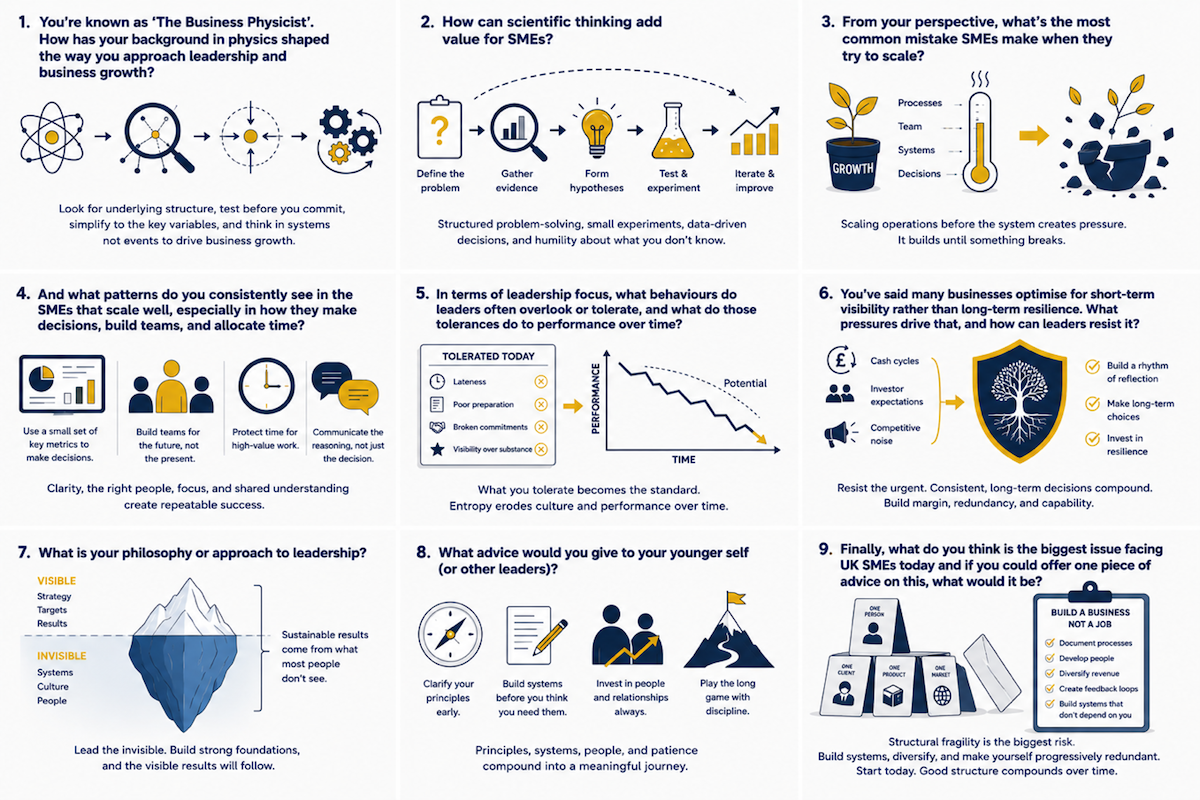
- You’re known as ‘The Business Physicist’. How has your background in physics shaped the way you approach leadership and business growth?
Physics taught me to look for the underlying structure in any system. Business is no different. Strip away the noise, and most problems follow a small number of governing principles.
It also gave me a set of habits: observe before you act, test before you commit, and always distinguish between what you know and what you assume. Those habits transfer directly to leadership.
The physicist’s instinct is to simplify. Not to oversimplify, but to find the smallest number of variables that drive the outcome. In startups and scale-up companies, where resources are limited, that discipline is not optional. It is survival.
I also think in systems, not tactical events. When something goes wrong, I do not ask who made the mistake. I ask why the system allowed it. That reframe changes how you lead.
- How can scientific thinking add value for SMEs?
Scientific thinking is structured problem-solving: define the problem precisely, gather evidence, form hypotheses, test them, and iterate. Most SME problems persist because leaders skip the first steps. They solve the wrong problem efficiently.
It also means running small experiments before committing to bigger bets. SMEs cannot afford to get it wrong at scale. The scientific method gives you permission to start small, learn fast, and scale what works.
The evidence is clear on one point: the best-performing teams are led by people who set clear expectations, make decisions based on data, and create feedback loops. Those are scientific principles, not personality traits. Any SME leader can learn them.
Perhaps most importantly, scientific thinking makes you honest about what you do not know. That humility is the foundation of good decision-making at every scale.
- From your perspective, what’s the most common mistake SMEs make when they try to scale?
They scale the operations before they scale the system. Revenue grows, but the processes, team structure, and decision-making frameworks stay the same. That is how a growing business becomes a chaotic one.
There is a physics analogy here. If you heat a gas without giving it room to expand, pressure builds until something breaks. Growth without structure does the same thing to an organisation.
The other common mistake is hiring for the current problem instead of the next one. Founders fill gaps reactively rather than building a team designed for where the business needs to be in two years.
Scaling well is not about doing more. It is about doing the right things repeatably. That requires discipline, documentation, and a willingness to build infrastructure that feels slow today but compounds tomorrow.
- And what patterns do you consistently see in the SMEs that scale well, especially in how they make decisions, build teams, and allocate time?
They make decisions based on a small number of well-understood and familiar metrics, not gut feeling. I expect every leader to know their financials at a high level: gross margin, proportion of recurring vs. one-off revenues, payroll costs. Perhaps five to eight metrics, no more. Check them regularly. That is calibration.
They build teams around the business they are becoming, not the one they are today. The best SME leaders I have seen hire capability and attitude, not just capacity.
They protect their time ruthlessly. In a small business, the founder’s attention is the scarcest resource. Where it goes, the organisation follows. If you spend 80% of your time firefighting, your company will always be on fire.
And they communicate clearly their reasoning, not just their decisions. The logic behind a choice is often more valuable than the choice itself, because it allows the team to make similar decisions without you in the room.
- In terms of leadership focus, what behaviours do leaders often overlook or tolerate, and what do those tolerances do to performance over time?
Culture is not what you put on the wall. It is what you tolerate. Every behaviour a leader ignores becomes an implicit standard. Tolerate lateness, and you have redefined punctuality. Tolerating poor preparation – you’re lowering the bar for everyone.
The most corrosive tolerances are the quiet ones: a senior person who undermines trust by way of inconsistent follow-through on commitments or rewarding visibility over substance. These erode team performance slowly and then all at once.
In physics, we call this entropy. Without active input, every system trends toward disorder. Culture is the same. It does not maintain itself. It requires constant, deliberate effort from the top.
The practical test is simple: if a behaviour would embarrass you in front of your best hire, do not tolerate it from anyone. Standards must be universal, or they are meaningless.
- You’ve said many businesses optimise for short-term visibility rather than long-term resilience. What pressures drive that, and how can leaders resist it?
The pressures are real. Cash cycles, investor expectations, competitive noise. When you are running a small business, the urgent always crowds out the important. That is the default mode.
But consistent, long-term decision-making compounds like interest. Small, aligned choices made over years produce results that short-term reactivity never can. The alternative is what I think of as the butterfly effect: inconsistent decisions pull the system into chaos, and no amount of effort restores control.
Leaders resist it by building a rhythm of reflection. Step back monthly, if not weekly, and ask: are the decisions we made this month moving us toward where we said we wanted to be in three years? If not, something needs to change.
The businesses that endure are the ones that treat resilience as an investment, not a cost. They build margin into their operations, redundancy into their teams, and patience into their strategy.
- How does an ‘exit mindset’ affect value creation?
An exit mindset optimises for appearances. A legacy mindset optimises for fundamentals. The difference is not subtle, and it shows up in every decision: how you hire, how you invest, how you treat customers and partners.
When you build to sell, you start making choices that look good on a slide deck but weaken the business structurally. You defer maintenance, overstate growth, and underinvest in culture because none of these shows up in a valuation model.
The irony is that the businesses which attract the best exit offers are the ones that were never built to exit. Acquirers pay premiums for resilience, recurring revenue, strong teams, and founder-independence — all of which come from a legacy mindset.
I am not against exits. But I am against building fragile businesses in pursuit of one. If you build something that endures, the optionality takes care of itself.
- You’ve described legacy as an overlooked part of entrepreneurship. Why should SME founders think about legacy early on?
Because the decisions you make in the first few years define the structure of everything that follows. Culture, governance, financial discipline, succession planning. These are not things you bolt on later. They are foundations.
I think of it as cathedral thinking. The people who started building the great cathedrals knew they would never see them finished. That did not stop them from laying the foundations properly. SME founders should think the same way.
Legacy also changes how you build your team. If you know the business must be able to run without you, you hire differently, delegate differently, and invest in people differently from day one.
The ultimate test of a founder is not whether the business succeeds while they are running it. It is whether it thrives after they step away. Thinking about that early is not premature. It is responsible.
- Finally, what do you think is the biggest issue facing UK SMEs today and if you could offer one piece of advice on this, what would it be?
The biggest issue is structural fragility. Too many UK SMEs are built around one person, one client, one product, or one market. When any of those is disrupted, the whole business is at risk.
The advice is simple in principle and hard in practice: build systems that do not depend on you. Document your processes, develop your people, diversify your revenue, and create feedback loops that tell you what is going wrong before it becomes a crisis.
If you are doing everything yourself, you have not built a business. You have built a job. And a fragile one at that. The goal is to make yourself progressively redundant, not because you are unimportant, but because the business you are building is bigger than any one person.
Start today. The compounding effect of good structure is enormous, but it only works if you give it time.
Dr. Serge Santos