
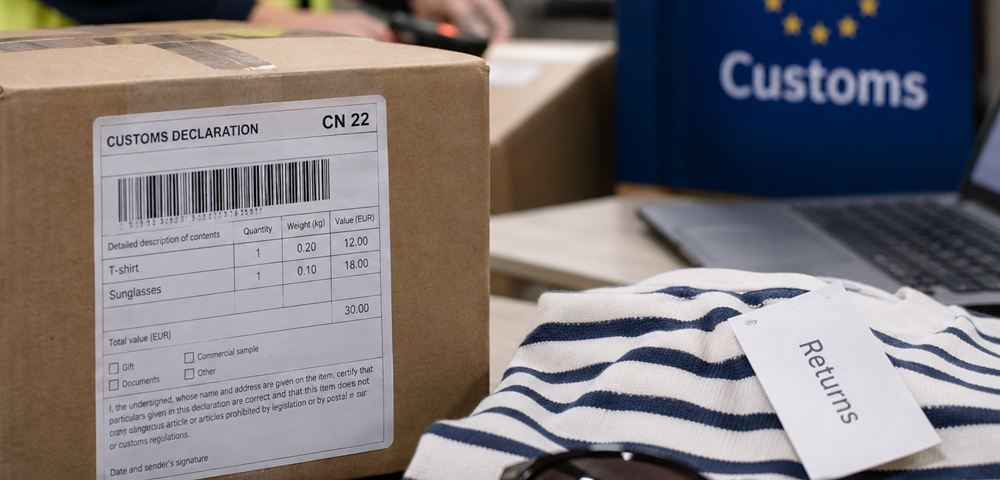
Two months after the EU introduced its new €3 customs duty on low-value e-commerce imports, the immediate impact looks different from many pre-July forecasts. National charges expected to add to the cost have not materialised as anticipated, but UK retailers selling into Europe face another problem: the new duty changes the economics of returns and exchanges. With the golden quarter approaching and further customs requirements due later this year, retailers should be looking beyond the cost of getting an order into Europe and calculating what happens when it comes back.
When the European Union introduced its new customs duty on 1 July, much of the industry’s attention focused on a simple number: €3. The reality is more complicated. The charge applies per tariff heading rather than simply per parcel. This means a shipment containing goods falling under two different tariff categories can attract €6 in customs duty. For retailers selling relatively low-value products, mixed baskets or accessories, that distinction matters. But according to Paweł Zakielarz, CEO of Shopreturns, the bigger issue is what happens after the sale.
“Retailers naturally model the cost of getting an order to the customer. What is much easier to overlook is what happens when the customer sends it back or asks for an exchange. That is where a relatively small customs charge can start multiplying across the transaction.”
A €3 duty is not always a €3 problem
Consider a UK retailer sending a €40 order to a customer in France containing products classified under two tariff headings. The customs duty amounts to €6 rather than €3. If the customer keeps the order, this is a relatively predictable cost that can be incorporated into the retailer’s landed-cost model. Returns make the calculation more difficult. The original import has already generated a customs cost. The product then needs to move back through the reverse logistics chain. If the customer requests an exchange rather than a refund, the replacement sent from the UK becomes another import into the EU and can trigger the duty again. One customer transaction can therefore generate several separate logistics and customs events. That is particularly significant in categories with structurally high return rates, such as fashion.
“Businesses need to stop calculating cross-border profitability only on successful deliveries,” says Zakielarz. “The more useful metric is the cost of the complete customer journey: delivery, potential return, verification, refund and, where applicable, replacement. A business can be growing its European sales while simultaneously losing margin through the reverse leg.”
Returns change the economics of low-value orders
A fixed customs charge affects a €15 or €20 purchase very differently from a €150 order. This creates a particular challenge for retailers selling accessories, lower-priced fashion products and mixed baskets. The commercial question is no longer simply whether European customers are willing to buy from a UK retailer. It is whether each transaction remains profitable after customs, fulfilment and returns are included. That distinction becomes increasingly important as businesses prepare for Black Friday and Christmas, when order volumes increase rapidly and the resulting returns often arrive several weeks later. A strong sales in November can therefore produce a very different profitability picture in December and January. For Zakielarz, this should change the way retailers approach the golden quarter.
“Q4 planning usually focuses on acquisition, stock and outbound fulfillment. This year UK retailers selling into the EU should add return scenarios to the same model. What happens to margin if returns rise by five percentage points? What happens if a significant share of customers choose exchanges? And how many of those replacements cross the UK–EU border again? Those are financial questions, not simply logistics questions.”
The first lesson from 2026: regulation can change faster than pricing models
The first months of the new regime have also demonstrated how quickly assumptions can become outdated. Ahead of July, retailers were preparing for a patchwork of potential national and European charges. France, for example, had introduced its own small-parcel charge earlier in the year but suspended it when the EU-wide measure came into force on 1 July. The French experience also demonstrated another feature of cross-border e-commerce: parcel flows respond rapidly to changes in cost. When France introduced its national measure, declarations through French entry points reportedly fell sharply as operators redirected flows through other European countries. An EU-wide duty changes that equation because retailers can no longer avoid the charge simply by changing the member state through which a parcel enters the single market. For UK retailers, this strengthens the case for reviewing not only prices but the architecture of their European operations.
At what point does local EU infrastructure make sense?
There is no universal order volume at which moving stock or returns infrastructure into the EU automatically becomes cheaper. The calculation depends on average order value, margin, product mix, tariff classifications, destination markets, fulfilment costs and return rates. But the new customs regime makes that calculation more relevant. For some retailers, continuing to fulfil individual orders directly from the UK will remain economically rational. For others, particularly those generating several hundred or thousands of EU orders per month, holding inventory inside the EU or processing returns locally may begin to change the economics materially. Local returns can be particularly important because the customer’s parcel can initially move domestically within their market rather than immediately beginning an international journey back to the UK. The returned product can then be inspected, consolidated, restocked, resold or transported in bulk depending on the retailer’s operating model. This shifts the discussion around returns from customer convenience to infrastructure.
“Returns used to be treated primarily as a customer-experience issue,” Zakielarz says. “They are becoming a question of where inventory sits, where products are inspected and how many times an individual order has to cross a customs border. For cross-border retailers, reverse logistics is increasingly part of the market-entry model.”
November brings another reason to review customs data
The July change is also not the end of the regulatory adjustment. Further customs-data requirements are approaching, including mandatory product identifiers from November. Retailers selling across multiple categories will therefore need accurate product and tariff information embedded into their processes rather than treating customs classification as a back-office exercise. The exact cost implications of further planned handling measures remain less certain, making scenario planning more useful than relying on a single forecast. For retailers preparing for Q4, there are therefore two different issues to manage. The first is compliance: making sure product and customs data are ready for the next requirements. The second is commercial: understanding whether the current fulfilment and returns model still makes sense after the July changes.
The metric retailers should calculate before Black Friday
The most useful exercise may also be the simplest: take one month of actual European orders and calculate profitability at transaction level rather than shipment level. That means including the tariff headings within each order, customs charges, outbound fulfilment, return rate, cost of the reverse journey and the number of replacements requiring another cross-border shipment. The result may show that the existing model still works.
But it may also reveal something that topline European sales figures do not: some products, baskets or markets have become substantially less profitable than others. And that is likely to matter more during the golden quarter than the headline €3 charge itself.