
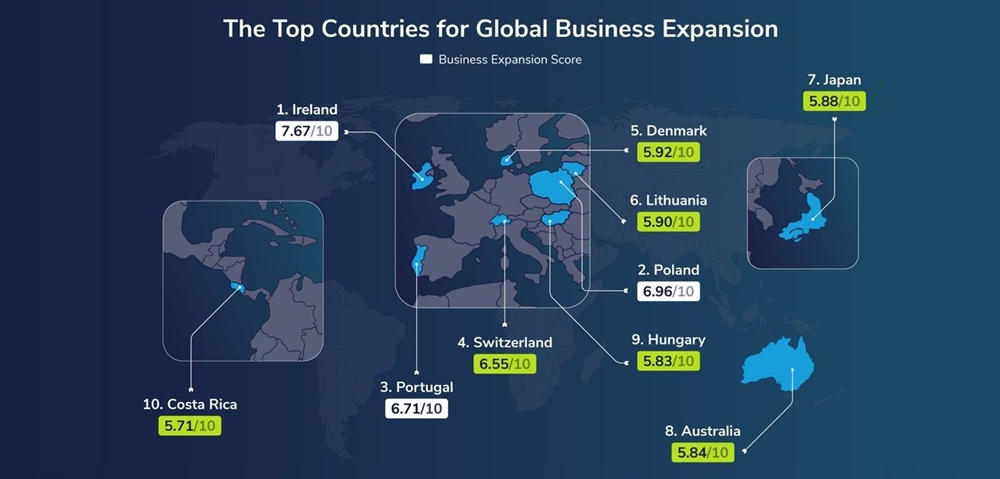
New research has revealed the best countries for British business owners to expand to as the Government plans to make it easier for foreign firms to move to the UK.
This recent announcement comes at a time when the UK hopes to build closer ties with the European Union to cut the cost of doing business and reduce border friction, potentially making a better understanding of cultural differences more essential.
For organisations aiming to scale internationally, experts at the cultural intelligence platform Country Navigator have analysed factors such as cultural similarities to the UK, corporate tax rates, GDP growth and more, to reveal the best countries for British businesses to expand.
The Top Countries for Global Business Expansion:
| Rank | Country | Headline Corporate Tax Rate | Annual GDP Growth Rate | Political Stability | Unemployment Rate | Cultural similarity score | Annual Google Searches for “Starting a Business in h” | Business Expansion Score /10 |
| 1 | Ireland | 12.50% | 2.60% | 78.70% | 4.60% | 6 | 11,000 | 7.67 |
| 2 | Poland | 19.00% | 3.00% | 64.00% | 3.00% | 6.2 | 4,100 | 6.96 |
| 3 | Portugal | 19.00% | 2.10% | 70.60% | 6.20% | 7.8 | 3,140 | 6.71 |
| 4 | Switzerland | 14.40% | 1.30% | 88.60% | 4.90% | 3.9 | 5,850 | 6.55 |
| 5 | Denmark | 22.00% | 3.50% | 76.80% | 5.50% | 3.4 | 2,460 | 5.92 |
| 6 | Lithuania | 17.00% | 2.80% | 72.50% | 6.70% | 4.9 | 2,090 | 5.9 |
| 7 | Japan | 31.50% | 0.10% | 81.50% | 2.50% | 6.7 | 6,070 | 5.88 |
| 8 | Australia | 30.00% | 1.40% | 79.60% | 4.10% | 4.4 | 16,260 | 5.84 |
| 9 | Hungary | 9.00% | 0.60% | 72.00% | 4.50% | 6.7 | 980 | 5.83 |
| 10 | Costa Rica | 30.00% | 4.30% | 83.90% | 6.80% | 7.6 | 680 | 5.71 |
1 – Ireland | Score of 7.67/10
Ireland ranks as the strongest country for business expansion. The country’s pro-business environment continues to attract international investment, with incentives such as R&D tax credits of up to 30-35%, alongside grant funding and support for companies entering the market.2
While its cultural distance from the UK (6.0) sits slightly above average (5.5), shared language, legal similarities, and established business ties help reduce practical barriers to entry, supporting Ireland’s position as a leading market for international expansion.
2 – Poland | Score of 6.96/10
Poland ranks second, driven by strong economic momentum and favourable labour conditions. The country’s network of Special Economic Zones (SEZs) continues to support inward investment by offering tax relief and financial incentives to businesses establishing operations.
With a cultural distance score of 6.2, slightly above the dataset average, Poland may present some differences in working practices. However, its combination of growth and cost efficiency continues to position it as a strong option for businesses expanding within Europe.
3 – Portugal | Score of 6.71/10
Portugal ranks third. In recent years, Portugal has introduced a range of initiatives to attract international business, including investment incentives, the Startup Visa program, and support for innovation-led companies. These efforts have helped position the country as an increasingly attractive destination for expansion, particularly for businesses seeking access to European markets.
However, its cultural distance from the UK (7.8) is higher than average, indicating greater differences in communication styles and business practices. While this does not limit opportunity, it may require more deliberate adaptation when entering the market.
Chris Crosby, CEO at Country Navigator, explains what businesses need to consider before expanding internationally:
“Expanding into a new market is often approached as a structural challenge – securing the right tax setup, hiring locally, and navigating regulation. In practice, the biggest barriers tend to be operational.
“How decisions are made, how feedback is delivered, and how relationships are built can vary significantly between markets. In unfamiliar environments, these differences can slow progress, create misalignment within teams, and affect how quickly a business gains traction.
“This is particularly relevant when entering markets with strong fundamentals, but that feel less familiar. Without a clear understanding of local expectations, businesses can struggle to translate strategy into execution, even when the opportunity is clear.
“For leadership teams, this shifts the focus from market selection to team readiness. Preparing employees to operate effectively across different cultural contexts through approaches such as cultural intelligence training can help reduce friction, improve collaboration, and accelerate integration.
“In my experience, the difference between a successful expansion and a stalled one is not the market itself, but how well a business adapts to it.”
Further insights:
- Denmark (3.4), Switzerland (3.9), Finland (3.0), and the Netherlands (3.3) all show closer alignment with UK business practices, recording cultural distance scores well below the average of 5.5, indicating fewer barriers to day-to-day collaboration.
- Australia leads with more than 16,000 annual searches for starting a business, followed by Canada (14,320) and New Zealand (12,170), all significantly above the global average of 3,594.
- The United States ranks joint 17th overall, with a score of 5.19, placing it well outside the top tier for business expansion despite its global scale and influence.
You can view the full report here.