
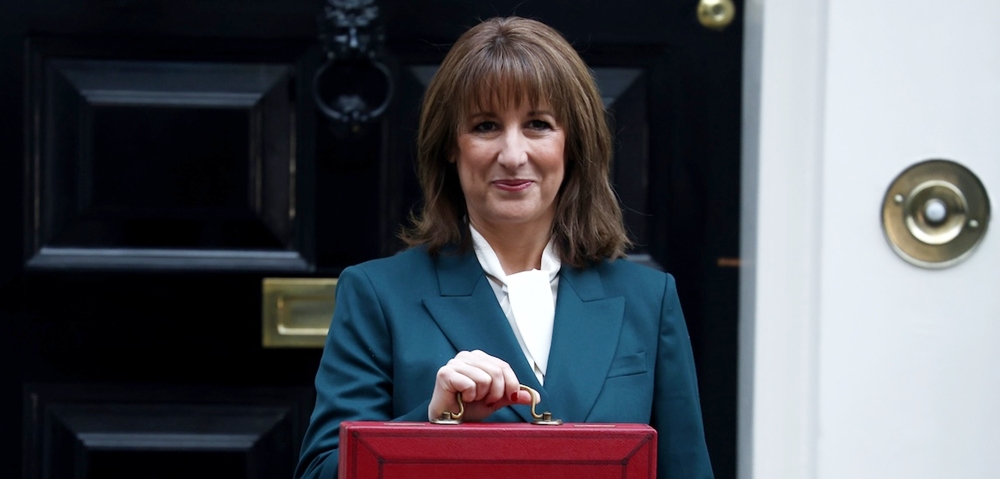
Following the Budget last Wednesday, Rob Morgan, Chief Investment Analyst at Charles Stanley, looks at how it will be impacting business owners and the self-employed.
This was a defining Budget for Chancellor Rachel Reeves.
After months of briefings and speculation, Ms Reeves arrived at the dispatch box under the glare of intense scrutiny – from political opponents, “working people”, high-net-worth individuals, and bond investors. But the group she arguably needed to tread most carefully around was business owners.
On the campaign trail in 2023, Rachel Reeves said Labour would be the most business-friendly government ever. And that if she were chancellor, her number one priority would be to help businesses get the economy growing.
Yet, it was employers who took the blows last year with unexpected hikes to the minimum wage and employer’s National Insurance contributions.
Heading into this Budget, pessimists in the private sector thought more drastic revenue-raising measures would be needed. Optimists – so often in short supply – were looking to finally get stability and support from the government to return to making long-term investments.
“Backing private enterprise with public ambition”
The chancellor – whose policies were spilled earlier in the day – opened with intent.
It took only 30 seconds for the chancellor to repeat the word “growth” (say it enough times and maybe it will appear?). Reeves talked about “spades in the ground and cranes in the sky.” And also promised to make Britain the best place in the world for entrepreneurs to “scale up and stay.”
There were three key announcements: for small businesses, for larger employers, and for landlords.
Small businesses to grapple with minimum wage increased
On the eve of the Budget, the Treasury confirmed that, for the third year in a row, minimum wages for 16- to 20-year-olds are going up. Here’s how that breaks down:
| Old | New | Increase | People (est.) | |
| National Living Wage Age 21+ | £12.21 | £12.71 | 4.1% | 2.4 million |
| National Minimum Wage Age 18-20 | £10 | £10.85 | 8.5% | 186,000 |
| National Minimum Wage Age 16-17 | £7.55 | £8 | 6% | 69,000 |
| National Minimum Wage Apprentices | £7.55 | £8 | 6% | 45,000 |
The media reaction flowed through straight away but not everyone knew where the impact would land. The announcement might not be as economically seismic as some commentary suggests, but it could be for small businesses, especially for those in sectors such as hospitality and retail.
On the economic side, the National Living Wage increase is a necessity to address the cost of living for the poorest in society. Business owners are wary that if staff costs go up unaffordably, they’ll simply get passed onto the customer, leading to price inflation, which, again, if not tackled directly, could lead to further wage inflation, and a doom loop the UK economy can’t get out of.
But the government will hope that because this wage hike only applies to 8% of the working population, the inflationary impact will be relatively muted. On paper, this should have a lesser effect when compared to last year’s rise in employer National Insurance contributions, which applied to almost every employed person in the UK.
The real issue with these wage hikes comes for thousands of small businesses struggling to keep costs down and unable to pass them on to customers – hospitality, retail, leisure, childcare etc. They may hold off hiring new staff or may need to reduce headcount entirely. This upped the ante for the chancellor to deliver targeted support to these sectors, and fortunately, she has.
Free training has been extended to under-25 apprentices in SMEs, offsetting their higher wages. And the chancellor has also announced “permanently lower business tax rates” for more than 750,000 retail, hospitality and leisure properties – the lowest they’ve been since 1991.
Of course, HMRC wins, too. Fiscal drag means revenue from business rates will increase this year and next as inflation pushes up the standard multiplier.
Pension salary sacrifice to be curbed, but not for a while
For larger employers, the chancellor has decided to put their salary sacrifice scheme on rations.
Salary sacrifice has long been a popular way for employers and staff to keep more of what they earn. Rather than taking their full salary in cash, employees could swap part of it – before National Insurance – for a benefit. Most commonly, that benefit is a pension contribution.
But from April 2029 – an annual cap of £2,000 will be placed on salary sacrifice into pensions. Beyond this cap, the NI benefits will stop.
Employers faced higher NI costs in the last Budget and business owners will be thinking “surely not again.” But this is, essentially, the story. A firm employing someone on £50,000 a year who sacrifices £5,000 now stands to give up a further £750 to NI.
From the employee’s perspective, £2,000 is also a very low cap. This mean the appeal of salary sacrifice will be diluted as a job perk, creating an awkward problem for employers who have historically placed it front and centre as part of a generous pension package.
Businesses that deliberately steered large parts of their workforces into salary sacrifice schemes to offset the higher NI costs will feel particularly aggrieved. Although, they have plenty of time to think of another plan.
Landlords’ income tax and a mansion tax come crashing in together
For decades, rental income has sat outside the National Insurance (NI) system because it was neither classed as employment nor self-employment. In the chancellor’s view, income is income – and should be treated the same whether it comes from a payslip or a property. This has led her to increase property income tax by 2%.
In response, some landlords will have no choice but to raise the rent.
Mortgage lenders will factor the added tax into future affordability assessments and stress-tests. If a landlord doesn’t have enough property income to meet mortgage coverage ratios – typically 125-145% of mortgage interest costs – they’ll struggle to remortgage. Other landlords may sell.
Before today, surveys from property bodies suggested many landlords were considering exiting the sector. This Budget might be the straw that breaks the camel’s back.
In combination with a “mansion tax” that was also announced, landlords who were thinking of selling up could accelerate those plans and trigger a massive rush in property sales before all the new rules come into force.
What wasn’t announced?
As expected, there were gambling taxes and sugar taxes targeting what can be seen as controversial sectors. But what we didn’t see were exit taxes – to the relief of the biggest businesses – or a lowering to the VAT threshold – to the relief of the smallest; side hustlers, sole traders and freelancers.
The UK has long relied on a relatively small number of wealthy taxpayers and corporations to fund a large share of the national purse, and an exit tax would have stopped their wealth from leaving with them overseas without being taxed.
The VAT threshold – the amount of turnover a business has to make before being subject to 20% VAT – remains at £90,000 in annual taxable turnover.
The upshot
The biggest measures affecting businesses, such as salary sacrifice, are pushed back years into the future. This gives time for the government to pull them if the business community turns against the government in the lead up to the next election.
Reeves still has a way to build bridges with some business owners, but with no headline shocks, at least the pessimists were wrong about this Budget. The fiscal black hole is half the size we all feared and with an early Christmas present in the form of an interest rate cut from the Bank of England looking likely, that might be enough to encourage businesses to invest in the future.