
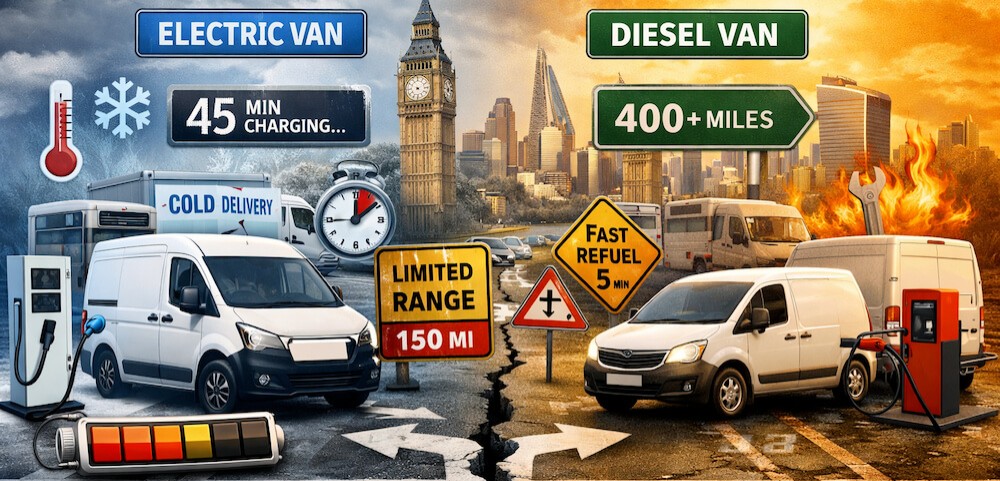

Debates around electric vans usually stall at charging infrastructure. This article deliberately removes that variable
Assume every combustion-engine van in the UK is replaced overnight with an electric one, and assume charging capacity is effectively unlimited. Under those conditions, does the UK economy continue to function as it does today, or do fundamental differences in energy density, refuelling time and operational flexibility begin to matter?
This is not a definitive economic assessment. Rather, it is a practical exploration of how electric vans align with the real demands placed on commercial vehicles. While the benefits of going electric are often discussed in terms of policy, cost and environmental outcomes, this article focuses on the operational realities that determine whether those benefits can be realised in day-to-day commercial use.
Energy density is a real bottle neck
When charging infrastructure is taken out of the equation, one of the most persistent differences between diesel and electric vans comes down to energy density, in other words, how much usable energy can be carried for a given amount of weight.
Diesel fuel contains roughly 12 times more usable energy per kilogram [1] than current lithium-ion battery technology. This gap is not a marginal efficiency difference; it directly influences payload capacity, range, and how a van behaves once it is put to work.
A typical diesel van carries around 80 litres of fuel, adding approximately 65 kilograms to the vehicle’s overall weight. That additional mass has a negligible impact on payload or handling, yet it enables a working range of 400 to 600 miles under real-world conditions.
By contrast, an electric van carries its energy in batteries weighing around 500 to 700 kilograms, depending on capacity. Although some models quote ranges of up to 220 miles per charge, these figures are typically measured under controlled conditions with little or no payload. In real-world use, a fully loaded van can see range fall by around 10% or more, with further reductions as additional energy demands are introduced.
This is why energy density remains a critical constraint. Battery weight is a fixed, permanent load, whereas fuel adds minimal mass and decreases as the vehicle is driven. As a result, usable range and operational flexibility are shaped not only by efficiency, but by how much energy must be carried before any work is done.
The implications become more pronounced in use cases that demand continuous or auxiliary energy, such as:
- Refrigerated vans, where energy is required not only for propulsion but also to maintain temperature throughout the journey
- Towing or heavy loads, which increase energy consumption and accelerate range loss
- Cab heating in cold weather, where electric systems must draw directly from the battery rather than repurposing waste heat from an engine
In these scenarios, the energy density gap does not simply affect range figures on a spec sheet; it shapes route planning, operational margins and the degree of risk a business must absorb to complete work reliably.
Long-distance hauling breaks the EV model
Even with charging infrastructure taken out of the equation, long-distance commercial work exposes a structural limitation in electric vans: refuelling time scales poorly with distance.
A diesel van operates on a short, discrete refuelling cycle:
- Refuels in 3–5 minutes
- Immediately returns to service
- Delivers 400–600 miles of real-world range
An electric van follows a very different pattern:
- Covers 150–220 miles per charge (less when loaded or at motorway speeds)
- Requires a 30–45 minute stop to recover roughly 80% of battery capacity
- Charging speed tapers, extending downtime further on long routes
The issue is not charger availability, but time compression. Diesel refuelling is a brief interruption; charging is a prolonged pause. That difference introduces a built-in time penalty that infrastructure density cannot remove.
For long or multi-stop routes, this has knock-on effects:
- Delivery schedules become less flexible
- Driver hours are harder to optimise
- Lost time cannot be easily recovered mid-route
This is particularly relevant for businesses where delivery reliability underpins day-to-day operations and customer expectations.
At scale, those pauses accumulate into lower daily mileage per vehicle and reduced fleet throughput. To maintain output, operators must either add vehicles, extend delivery windows, or accept higher downtime.
Cold weather exposes another structural constraint
Winter conditions introduce an additional load that electric vans cannot avoid: cab heating. In the UK, meaningful heating is required for roughly five months of the year, covering a substantial portion of the operating calendar rather than a marginal edge case.
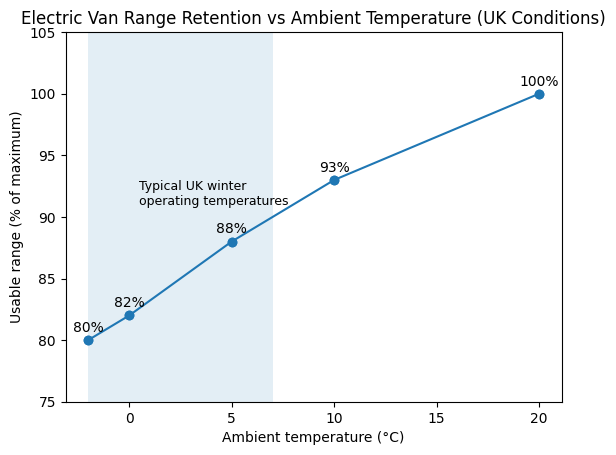
In an electric van, heating draws directly from the same battery used for propulsion. This creates a consistent winter penalty that compounds with payload and driving conditions. A van rated at 220 miles under unloaded, mild conditions can see real-world range fall to around 150 miles in colder weather, with further reductions once the vehicle is fully loaded.
By contrast, combustion-engine vans source cabin heat from engine waste heat. Because the engine generates heat regardless of season, heating the cab has no meaningful impact on range or refueling frequency, whether it is summer or winter.
The operational consequences are subtle but important. In colder months, route planning for electric vans becomes:
- More conservative, with wider safety margins built in
- More risk-averse, reducing willingness to extend routes or absorb delays
- Less flexible, limiting mid-day changes, rerouting, or additional jobs
Individually, these adjustments appear manageable. Collectively, they reduce operational agility across an entire season. What was previously a continuous, adaptable workflow becomes one that must account for weather-driven range uncertainty alongside distance, payload, and time.
Did you know? In cold conditions, lithium-ion batteries become chemically less efficient. As temperature drops, the internal resistance of the battery increases, which limits how quickly energy can be drawn from or returned to the cells. At around 0 °C, an electric vehicle can typically lose approximately 10–20% of usable range [2] and take longer to charge compared to warmer conditions.
When Range Isn’t the Problem: Payload in Electric Vans
We have already touched on energy density, which refers to the amount of usable energy per kilogram and ultimately feeds into the same constraint that governs payload. What becomes more revealing, however, is the average loss of payload that occurs when a van transitions from combustion to electric power.
Modern electric vans have largely succeeded in preserving cargo volume. Low-profile, floor-mounted battery designs mean that load space is now more often comparable with diesel equivalents. In most cases, volume is not the limiting factor.
The reduction in payload is instead a direct consequence of battery weight. So how do these differences play out across the different van size categories?
Small vans
- Diesel payload: ~1,050 kg
- Electric payload: ~780 kg
- Difference: ~270 kg
Mid-size vans
- Diesel payload: up to ~1,335 kg
- Electric payload: ~1,000 kg
- Difference: ~335 kg
Large vans
- Diesel payload: ~1,400–1,865 kg
- Electric payload: ~645–690 kg
- Difference: 710 to 1,220 kg
Note: In some cases, a small electric van can offer a higher payload than a larger electric model, clearly illustrating the current payload limitations of electric vans. While a large van may provide up to three times the load volume, it can barely compete against small electric vans.
Conclusion: Why Pace Matters More Than Direction
Taken together, the constraints explored in this article point in one direction. A rapid, full replacement of combustion-engine vans with electric equivalents would introduce measurable negative impacts: higher cost per unit moved, lower fleet throughput, reduced payload efficiency and tighter operational margins, particularly in long-distance, cold-weather and high-load use cases.
The economy would adapt, but not without friction. That adaptation would come in the form of more vehicles, more downtime and higher costs to deliver the same output. These are not transitional inconveniences caused by missing infrastructure; they arise from current limits in energy density, charging time and battery mass.
The implication is not that electric vans are unviable, but that the timing of the transition matters. Phasing out combustion-engine vans faster than electric technology improves effectively locks these inefficiencies into the system. Phasing them out in step with improvements in battery energy density, charging speed and cold-weather performance allows the transition to occur without embedding avoidable economic drag.
In other words, the question is not whether the UK should move to electric vans, but whether it does so at a pace dictated by targets or by technology.
Source
[1] A comparative study of diesel engines and battery electric propulsion systems. International Journal of Naval Architecture and Ocean Engineering. https://doi.org/10.1016/j.ijnaoe.2025.100681
[2] Finnerty, J. (2024, December 12). Do electric cars lose charge in cold weather and how much EV range? GRIDSERVE. https://www.gridserve.com/how-much-range-do-electric-cars-lose-in-the-cold-and-why/