
The B2B buying journey is undergoing rapid change, with deals now hinging on more decision-makers, channels, and technologies.
To help marketing and sales teams hit the mark, the experts at B2B demand generation agency Sopro have collated and analysed the latest industry statistics to highlight the most influential trends driving change.
Top 5 current B2B marketing trends and statistics:
-
Nearly a third of B2B marketers say buyers are further through research before engaging with sales
Buyers are arriving later in the journey – by the time they speak to a sales rep, many have already searched, compared, read reviews, checked competitors, asked peers, and used AI tools to narrow their options. Buyers are forming opinions long before they become visible in your CRM.
-
The average B2B buying decision now involves over four people
Most B2B deals now need approval, input, or influence from several people. That means marketing needs to support more than one conversation. A strong campaign should help different stakeholders understand the value from their own point of view.
-
More than 9 in 10 B2B buyers report using AI in their buying process
Buyers are using AI to summarise information, compare options, shape questions, and speed up research, meaning that the content that a business is producing may directly influence buyers, but it may also influence the AI tools that help them make sense of the market.
-
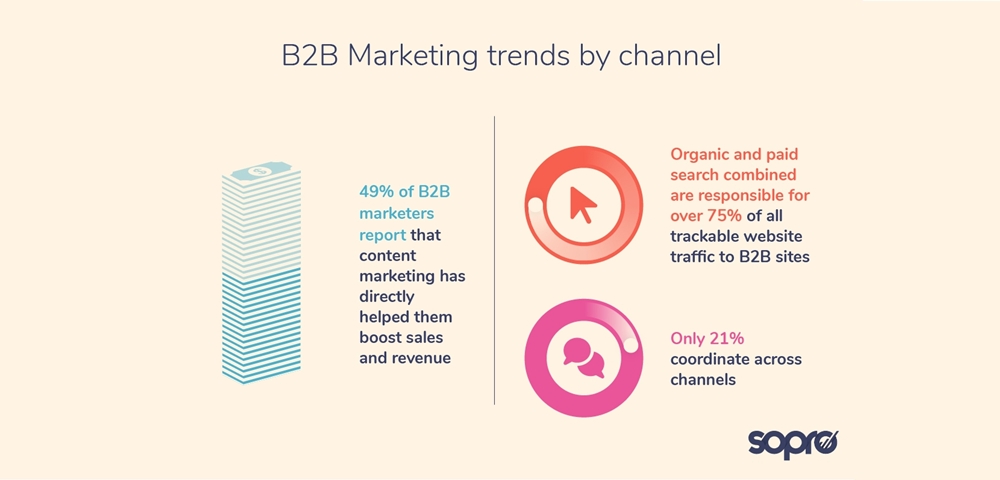
B2B customers are using double the interaction channels during the buying journey than they used 10 years ago
This growth changes how marketers need to plan campaigns. Buyers expect consistency across channels, even if different teams own each one internally. A fragmented internal setup can quickly fragment the buyer’s experience.
-
8 in 10 buyers are likely to engage with a brand that has relevant case studies or social proof
Case studies help buyers see what success looks like in a real business. They show the problem, the approach, and the result. They also give internal champions something useful to share with colleagues. For high-consideration B2B purchases, accessible social proof can move a buyer from interest to confidence.
However, our State of Prospecting report also found that harnessing social proof in active marketing efforts can make outreach less effective. The reason for this? Social proof works because it’s other people saying you can be trusted – trying to recreate this effect in your own voice, e.g. in an email, just doesn’t have the same effect.
Kit Smith, Content Manager at Sopro, comments:
“The biggest trends shaping B2B marketing are longer buying journeys, larger decision-making groups, AI-assisted research, greater demand for personalisation, and rising pressure to prove ROI.
“Buyers are doing more research before speaking with sales. They are using more channels, asking for stronger proof, and relying on AI tools to compare suppliers. That means marketers need to show up earlier, stay useful for longer, and make it easier to build trust.
“The strongest strategies rarely rely on one channel alone – emphasising the importance of a multi-channel approach, e.g. where search captures active demand, content builds trust, email creates direct engagement, paid social supports reach and retargeting, and sales outreach turns interest into conversations.”
You can view the full report here to learn more.