
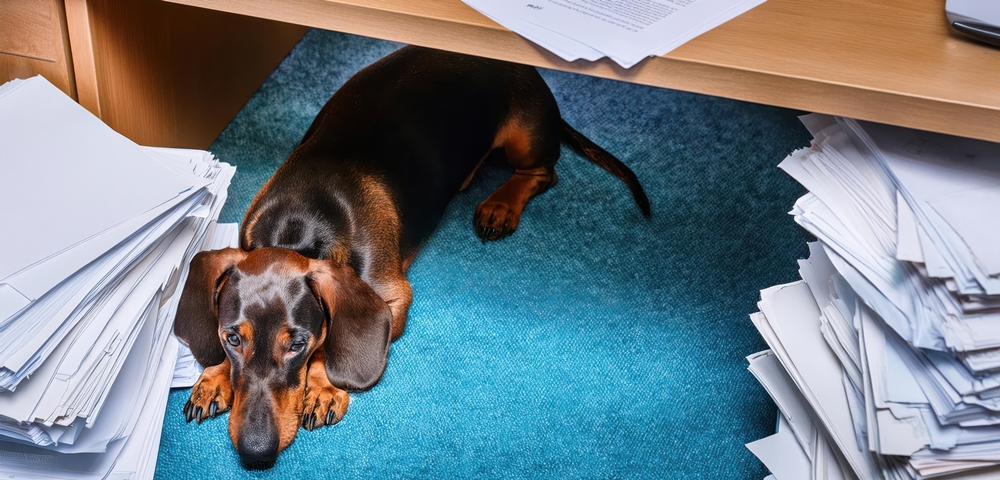
Jo Hinds, COAPE-certified behaviourist and Dynamic Dog Practitioner at Years, says some dogs can thrive in an office environment, but others may find it overwhelming, even if they appear calm.
Jo said: “Bring Your Dog To Work Day can be a lovely idea, but it is important to remember that the office is not a neutral space for a dog. It is full of unfamiliar smells, movement, doors opening and closing, people approaching, food, meetings, noise and long periods where the dog is expected to simply wait. Some dogs cope beautifully with that. Others may look quiet but are actually overwhelmed. A dog lying still under a desk is not always relaxed. Sometimes they have simply shut down.”
The lesser-known signs a dog is not coping in the office
Many owners miss early signs of stress because they do not always look dramatic.
Jo said: “People tend to look for barking, growling or trying to escape, but stress can be much more subtle. Yawning when they are not tired, lip licking, turning their head away, refusing treats, excessive panting, shaking off when they are not wet, pacing, hiding behind their owner, freezing, whale eye when approached or being unable to settle can all be signs that the office is too much.
Another behaviour people misread is constant socialising. A dog going from desk to desk, unable to switch off, is not necessarily having the time of their life. They may be over-aroused and struggling to regulate.”
Which dogs are more likely to cope with office life?
Dogs most likely to manage well in an office are usually confident, comfortable around strangers, able to settle independently and not easily startled by noise or movement.
Jo said: “An office dog does not need to be perfect, but they do need to be able to relax around people, ignore everyday distractions and cope with short periods where attention is not on them. Dogs that are anxious, reactive, noise-sensitive, highly excitable, very young, elderly, in pain, recovering from illness, or uncomfortable around strangers may find the office stressful. Breed alone does not tell you whether a dog will cope. Temperament, training, health, routine and previous experiences all matter.”
How long should a dog stay in the office?
Jo advises owners not to bring their dog in for a full working day straight away, especially if it is their first time.
She said: “The first office visit should be short. I would suggest starting with a calm one or two-hour trial, ideally at a quieter time of day, rather than expecting a dog to manage eight hours in a busy workplace. If that goes well, build up gradually. A full day can be a lot for many dogs, even confident ones.
They need proper rest, toilet breaks, water, space away from people and time outside, where they can truly relax, sniff and decompress, ideally no where there is more to deal with and where they are not constantly being approached.”
Owners should also have an exit plan.“If your dog is showing signs of stress, the answer is not to push through the day. You need to be able to take them home, move them somewhere quieter, or arrange alternative care.” said Jo.
What owners should not do
Owners should avoid arriving unprepared or assuming colleagues will help manage their dog.
She recommends employers consider:
- Staff education on dog body language and the signals what before growling and biting and consensual handling, including the care giver of the dog understanding the subtle signs of stress before anyone is at risk.
- Rules about when the dog is resting to not approach them on their safe space
- Rules about not disturbing them when eating
- Rules that no one feeds the dog dogs can quickly put on weight and this can be the quickest way to stop the dog from settling if everyone eats at their desk
- Whether dogs need to be approved before coming in
- A limit on how many dogs can be in the office at once
- Dog-free zones for colleagues who are allergic, nervous or simply do not want dogs nearby
- Clear rules around kitchens, meeting rooms and communal eating areas
- A process for dealing with barking, toileting accidents or signs of stress
- A requirement that dogs are vaccinated, insured and healthy
- A rule that dogs must never be left unattended
- A rule that if a dog is unwell or injured they are to stay at home and rest this can change emotion and mood states
- Continual assessment by the employee who cares for the dog, to ensure they are still coping.
Jo says owners should think about how office days affect their dog’s normal routine, including feeding, naps, toilet breaks and walks. “Dogs thrive on predictability. If office days mean their meals, walks, rest and toilet breaks become chaotic, that can affect their behaviour.
A dog that is hungry, overtired or overstimulated is much more likely to struggle. Keeping feeding times consistent, giving them access to fresh water, and making sure they have proper downtime can make a huge difference.
Final advice for owners
Owners should ask whether their dog would genuinely benefit from being in the office, rather than whether they would personally like to bring them in.
Jo said: “Some dogs love office life. They settle beautifully, enjoy gentle interaction and benefit from being with their owner. But for others, home, daycare or a trusted dog walker may be far better. The kindest thing you can do is watch the dog in front of you. If they are relaxed, able to rest, eating normally, responding to you and recovering well after the day, that is a good sign. If they are tense, clingy, restless, overexcited, barking or exhausted afterwards, the office may not be the right place for them.”