
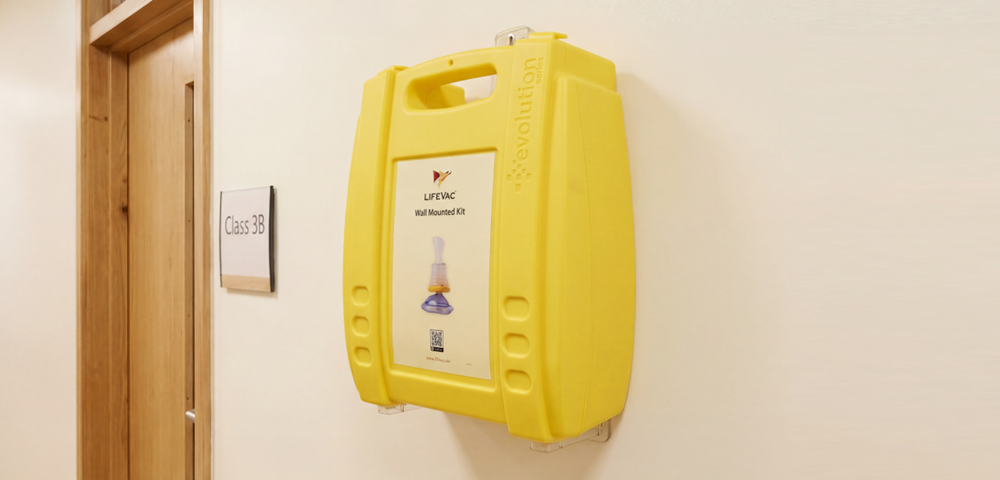
Employers are being urged by LifeVac Europe® to ask themselves how prepared their workplace is to deal with a choking incident and to review their emergency response procedures and first aid provision.
While many organisations invest heavily in fire safety, mental health support and defibrillators, choking remains an often-overlooked workplace risk despite thousands of employees eating at their desks, in staff rooms, canteens and hospitality areas every day.
LifeVac Europe®, which manufactures the regulated non-invasive airway clearance device used in numerous workplaces worldwide, says employers should be asking whether their teams would know what to do if a colleague started choking.
Eric Banagan, Founder and Managing Director of LifeVac Europe®, said: “Most employers have robust plans in place for fires, accidents and even cardiac arrests, but choking emergencies are rarely discussed despite the fact they can happen in any workplace, at any time.
“A simple lunch break, team meeting or work celebration can quickly turn into a life-threatening situation. Choking incidents develop rapidly and every second counts. Employers need to consider whether they have the training, equipment and confidence to respond effectively while waiting for emergency services to arrive.”
Choking is often viewed as a risk confined to restaurants, care settings or homes, but the reality is that a choking emergency can occur in any workplace, from offices and warehouses to shops and hospitality venues.
The company, which manufactures LifeVac® for the UK, Europe, the Middle East and Africa, reports that more than 6,100 lives have been saved worldwide using the device.
The discussion comes about as businesses place increasing emphasis on employee wellbeing, health and safety, and risk management.
Eric continued: “Employers have both a moral and legal responsibility to provide a safe working environment. We know that businesses invest in defibrillators, mental health first aiders and wellbeing initiatives, which is fantastic, but choking preparedness deserves a place in that conversation too.
“The question every business should ask is simple: if a member of staff started choking today, would somebody nearby know exactly what to do?”
The company hopes that in the future more employers will begin viewing choking preparedness in the same way they now view defibrillators: not something they expect to use, but something they are grateful to have when every second counts.
For more information visit https://www.lifevac.uk
For interviews, images and kits, contact Natalie Trice via natalietrice@natalietrice.co.uk