
Julia Payne, founder of Fractional CMO Services, explores why founder-led businesses often hit a ceiling as they expand and highlights five warning signs that growth is beginning to outpace operational capability.
You’d be hard pressed to find a business that doesn’t aim for growth, be it visibility, customer numbers, and market share, or service reach and scope. Ultimately, it all means revenue. There’s just one thing to be aware of.
Many founders assume the techniques that took their business from day one to early success will keep driving wins. This couldn’t be further from the truth.
Start-up structures were never designed to support scaling ambitions. The structure simply isn’t there, because it never needed to be. A corporate lunch supplier can reach its first targets by providing sandwich platters to local offices, each benefitting from direct founder involvement, for instance. But once that expands into national contracts, online ordering, and a myriad of different procurement requirements, existing processes become unsustainable.
What once felt agile now feels clunky. Delays creep in as teams fall under pressure and the founder realises they can no longer make every decision alone. It’s time to implement strategies and frameworks the whole team can apply iteratively for sustainable scaling – bringing growth and business models into alignment.
When models clash
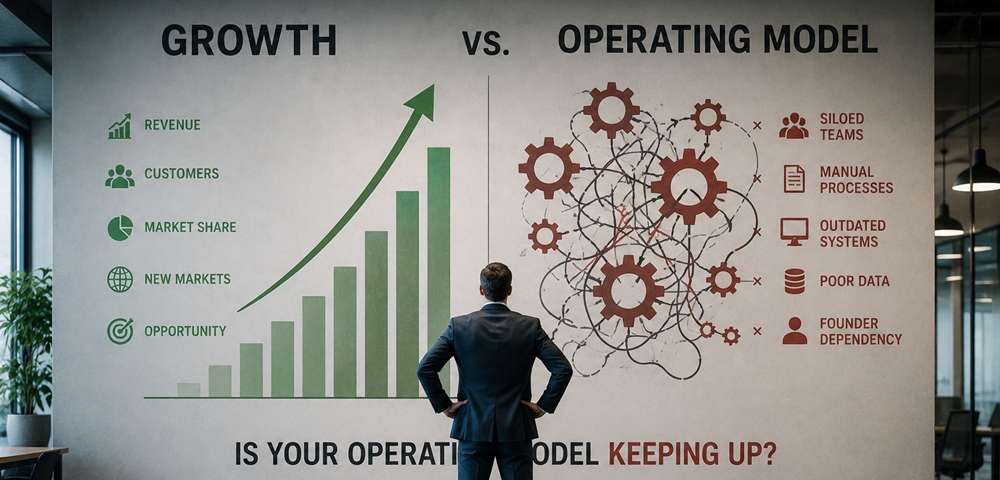
While growth models are determined by expansion methods including new markets, customers, revenue routes, and commercial ambitions – business models constitute the machinery beneath, namely, people, processes, systems, data, delivery, and decisions. When both evolve together, progress is controlled. When growth outpaces the business behind it, however, every new opportunity creates strain, even when you appear to be driving momentum.
Here are five signs your business model may be struggling to keep up:
- The founder’s still driving
Founders often play a starring role in early growth, closing deals, explaining the offer, rescuing tricky conversations, and signing off decisions nobody else can yet make. At a certain stage, however, if every major commercial choice still runs through one person, the company hasn’t built a scalable model. It’s built dependency.
According to McKinsey, 78% of companies that find product-market fit still fail to scale, because what worked to generate initial demand is no longer enough. What will work is codifying what makes the founder effective – customer profiles, qualification rules, pricing logic, sales playbooks, decision rights, and value messaging. Shared assets move the needle much more meaningfully than isolated knowledge.
- New routes to market are still being pushed through old funnels
Funnels will likewise need to be updated. Smaller companies tend to start with one simple way of winning, be it referrals, founder-led relationships, or a core product. Everybody knows where leads come from, who follows them up, and what the customer expects.
Growth shakes things up. New business may now come from partners, online enquiries, outbound campaigns, renewals, upsells, events, procurement frameworks, or new sectors. Each route brings new expectations, from personal conversation to formal paperwork and from accuracy to speed and convenience.
With customers arriving in different ways, the business needs to create different processes, roles, and handovers. One funnel cannot serve every opportunity forever.
- Everyone’s busy – with their own thing
Of course, it’s still necessary to create consistency and co-ordination across this variety of processes. One of the clearest signs of strain is when all teams are working hard, but not together. Marketing designs campaigns as sales focuses on pipeline, customer success thinks about retention, and finance watches margin. Each view matters, but if nobody can see the full picture, decisions are made from fragments that ultimately, do not provide a unifying customer experience.
This is where Revenue Operations, or RevOps, becomes vital. Put simply, RevOps brings teams together around the same processes, data, technology, and goals, so everyone can understand how demand becomes pipeline, how pipeline becomes revenue, and where value is being won or lost. It replaces founder dependency with structures that continue working even when the founder isn’t present.
This might explain why Gartner expects 75% of the highest-growth companies to adopt RevOps thinking this year. Scale depends on joined-up thinking – not isolated effort.
- Revenue is rising, but profit isn’t
Even when revenue is the focus, leaders must look beyond headline figures to find out what growth is really costing. Toplines can look healthy, despite the business not actually becoming more resilient. Sales are increasing, new clients are coming in, and growth appears to be moving forward – but if margins are tightening, delivery is becoming more costly, or teams are spending more time servicing complexity alongside this, you’re not necessarily scaling for the long term.
A larger client might bring in more revenue, for example, but may also require additional reporting, meetings, customisation, and senior input, or longer payment terms, for example. On paper, you’ve seized an opportunity. In practice, that client may be quietly draining time, people, and profit.
Scalable business models therefore look beyond revenue. Leaders must understand which customers, channels, products, and services are genuinely profitable, and which are creating hidden costs. Growth is only meaningful if you can afford to sustain it. A RevOps structure can help you work this out.
- You’re running on workarounds
Finally, businesses need to be wary when everyday progress depends on fixes, favours, shortcuts, and manual intervention. When one “temporary” solution becomes a permanent process, or one senior person becomes the unofficial answer to every question, it’s a clear sign you’re stalling.
Teams may still be delivering, but only because they’re compensating for gaps in the model. Rather than asking people to push harder to solve this, leaders need to revisit the business model, ensuring it makes the right work easier to repeat.
Fix the foundations before you hit the glass ceiling
If growth suddenly feels slower, harder, or more dependent on senior intervention or patching strategies, it’s time to take stock. Business models need to be rethought when new opportunity creates more friction than forward momentum. The shift from founder-led to scalable growth depends on building systems that help teams think, decide, and deliver for themselves. This is what makes companies, resilient, scalable and valuable.
1 Comment
Pingback: Your Business Is Growing. Is Your Operating Model Keeping Up?