
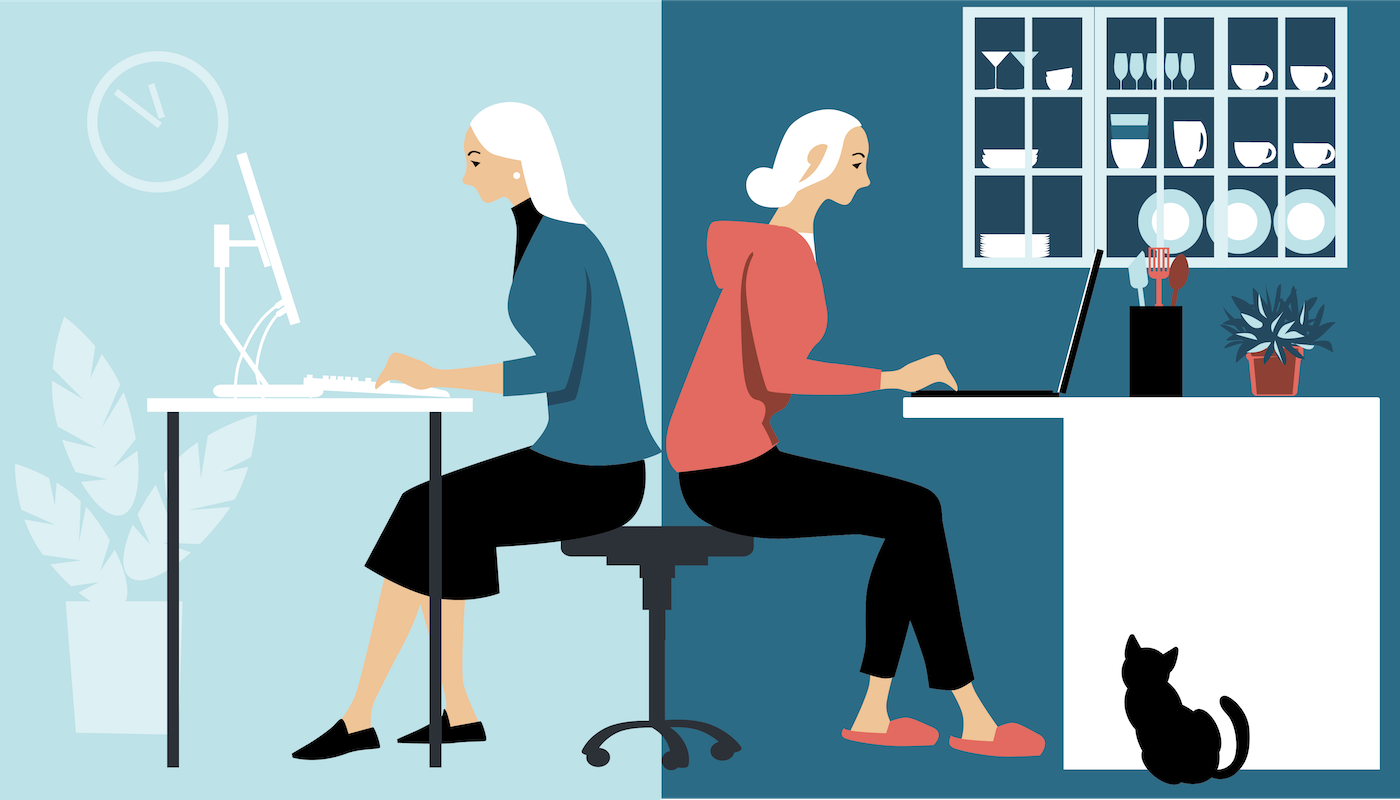
Among the many adaptations we made during the Covid-19 pandemic, one of the most impactful has been home working. For most owners and employees this was temporary, but for some the advantages of working from home have led to calls for a more permanent change in their work-life balance. One such route is hybrid working, where people have some type of home-working arrangement alongside time spent in the office. In fact a 2020 survey by YouGov of 4933 adults in the UK found that 57% wanted the option to work from home to continue, of which 18% wanted to work fully remotely and 39% wanted the option to work from home some of the time (Smith, 2020).
Much of our current knowledge about work cultures that are not ‘traditional’ (i.e. not ‘office work’) predates the pandemic and is based primarily on research that has been specifically into ‘remote’ working. However, the pandemic has demonstrated the need to look beyond the dichotomy of office work and remote work, to considering blended or ‘hybrid’ ways of working.
 Dr Shruti Raghuraman is part of The Inclusivity Project, which is funded by the European Regional Development Fund and brings together research from the European Centre of Environment and Human Health at the University of Exeter in collaboration with partners Age UK Cornwall and Isles of Scilly, disAbility Cornwall and Cornwall and Isles of Scilly Local Enterprise Partnership.
She conducted a study into how SMEs could develop flexible, hybrid cultures of work that are inclusive, fair and equitable. Her focus was on the idea of a co-design approach to hybrid working, which features the active involvement of all stakeholders who will be benefit from it. It’s an approach recommended by the Chartered Institute of Personal Development (CIPD).
She worked with Age UK in Cornwall and the Isles of Scilly to review the development and implementation of a co-design process. While Age UK is a national charity, it is formed of smaller regional organisations with full business responsibility. The Cornwall enterprise is a mid-sized SME with 140 staff and a 300+ volunteers. Dr Raghuraman worked alongside their Chief Executive Tracey Roose in implementing hybrid working, with the aim of discovering how other SMEs could best implement a hybrid process within their organisations.
Hybrid working without reinventing the wheel
Whether an SME has two staff or 250, it must balance the need for change with the complexities of achieving it. Transitioning a workforce of any size to hybrid working could place an additional burden on the business at a time when resources and funds are already significantly stretched due to the pandemic.
“The outcomes of our research are aimed at primarily at organisations that do not want to co-design solutions from scratch but need a quick and handy sense of what to watch out for and how to navigate the change,” says Dr Raghuraman. “We therefore created a resource that supports SMEs and the voluntary/third sector to prepare for, be responsive to, and deal with the uncertainty and change that comes with transitioning to a hybrid model of work.
 “It’s a tried and tested approach to co-designing a hybrid workplace culture that is fair, equitable and addresses the needs of the workforce in a frontline organisation. This process may be used as a template for any organisations of a similar size, structure and nature of work to plan and execute their own hybrid work model.”
It’s an approach common to other parts of the Inclusivity Project. Their Knowledge Exchange service, for example, has empowered SMEs to overcome the challenges and barriers they have faced in their aim to be a more inclusive workplace, both pre and post pandemic.
Tracey Roose at Age UK says: “We have implemented hybrid working, but this isn’t an offer we can make to every single person across all our services. Some have to be run from offices or at certain times. But it is an offer we can make to the majority, to fit in with caring responsibilities, abilities, need and lifestyle.
“For many, cost of living challenges will increase the need for business to be flexible; changing hours to reduce carer or childcare costs; finding space to work close to home but not necessarily in the home; offering electric vehicle access to reduce transport costs; offering flexible loans – all form part of a wider strategy for inclusivity.
“We’ve looked at what our staff and our volunteers feel about hybrid and flexible working, and have been co-designing a hybrid working culture with The Inclusivity Project, looking at opportunities to overcome some of the challenges. We’re creating a framework for what a hybrid working environment might look like in the future and, in doing that, being much more inclusive about age, and the places that people might want to live and work.”
Tracey found that, during the pandemic, technology put a distance between managers and their teams, with video meetings tending to be much more transactional. So their staff developed ideas around different ways of connecting with each other, and how people can have an opportunity to talk off agenda and gain support and recognition. These included setting up a buddy/peer support system for people to connect around the place they live; a programme of support events; inductions that make people feel connected; monthly reflective practice sessions offering a safe space for teams to come together; and ‘lunch and learns’ on specific topics bringing people together across the organisation.
Tracey acknowledges this is a journey and is re-visiting some of the suggestions the teams made in the engagement with The Inclusivity Project to see what else they might do, such as additional digital support.
Putting hybrid working into practice
Dr Raghuraman is clear that the co-design approach, where there is engagement between all parties, is key to making hybrid working effective.
But one size does not fit all, and any co-design approach must be tailored to the organisation’s size, capacity and goals, as well as staff roles, responsibilities, needs and preferences. The Inclusivity Project has created a process document that SMEs can use to create a co-designed hybrid working culture that helps to reap the benefits and overcome any pitfalls.
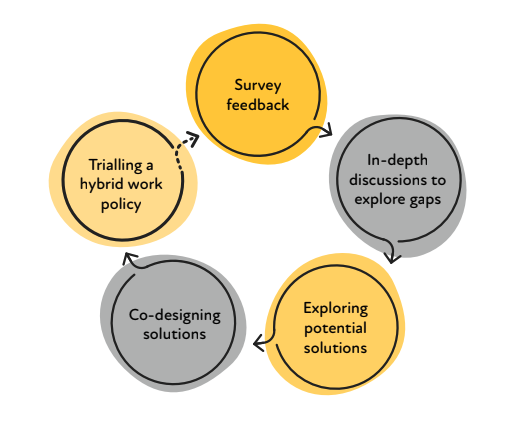
The stages of the process are:
- Scoping the organisation’s unique needs and preferences, typically through a survey to get feedback on specific issues.
- Using the survey outcomes to facilitate key discussion points for a more focused, in-depth dialogue with a small sub-section of the workforce.
- Identifying potential solutions that align with the purpose of the SME, that don’t challenge roles and responsibilities of staff and offer a fair reallocation of the organisation’s resources.
- Co-designing a draft hybrid blueprint that is flexible, adaptable, and amendable to feedback from the workforce.
- Trialing a hybrid work policy or practice, ideally with smaller teams that are not frontline, that can then be refined and rolled out through the organisation.
Dr Raghuraman adds: “Culture change is a slow process and will require adjustments over time. It is important to set these expectations at the start of the process. Periodic review and feedback from the workforce not only ensures transparency and consultation, but also creates expectations that this is a marathon, not a sprint.
“Above all any development of hybrid working must be genuine and transparent, and not just a managerial ‘tick-box’ exercise. It must have real impact on the wellbeing of the workforce. Hybrid work offers up an opportunity to make work more accessible, enjoyable and enriching to our lives, as well as good business sense.”
The findings of the research by Dr Raghuraman are available on The Inclusivity Project website: https://theinclusivityproject.co.uk